This is the Terrassen-Mosel, etched on the head of a pin.
If there are any precedents to what Julien Renard is doing in the Terrassen-Mosel, they would have to be the rapier-like wines of Stefan Vetter or Jonas Dostert. Yet neither Vetter nor Dostert work with Riesling; neither work in this most extreme place.
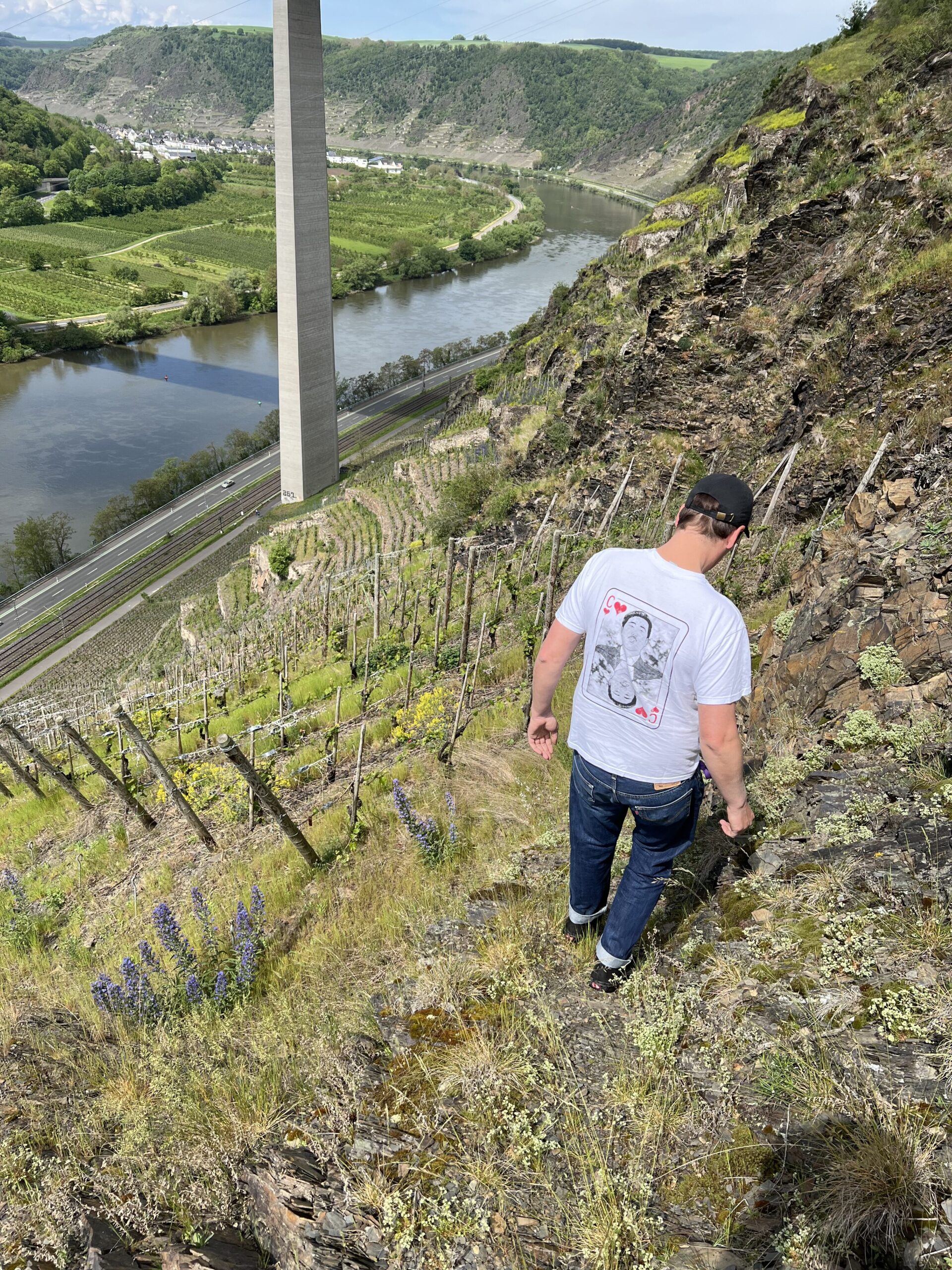
The Terrassen-Mosel is one of the most dramatic viticultural landscapes on earth. To me the cliff-vineyards that surround the charming town of Winningen feel like strategic fortresses; bulwarks built primarily for defense, and only later embellished with vines – almost as if an afterthought.
If I’m indulging in the landscape perhaps a bit more than normal, I’m doing so because there is a very strong relationship between the severity of the landscape, the severity of the physical work, the sheer exertion, and Renard’s personal journey into wine.
Julian said to me something like: “Looking at these vineyards, at first I was afraid – and it was months and months of pain. But you have to climb the vineyards, you have to push, and in the end you have to climb up within yourself.”
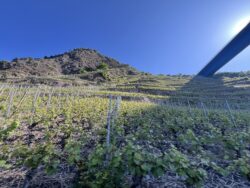
I think this is actually a profound insight, the connection between the outer and inner spaces, between the physical world and the psyche. The general idea is pretty clichéd of course. At its most crude, this is the aesthetic philosophy of those inspirational posters that line office and school hallways throughout the world: “Freedom” written boldly in some horrible font below a picture of an eagle soaring. “Grit and tenacity” written below the picture of a climber on El Capitan.
Yet the idea is referenced less, I think, in the world of wine. Most vineyards are, I suppose, sorta banal.
The Terrassen-Mosel is not.
This place is directly on the edge of unbelievable – as if it were a task arranged for the sole purpose of seeing if it was actually possible. And I think the people who work this landscape, who make wines here, also have a special mental fortitude – a strength, a will, a certain questionable degree of stubbornness?
At their absolute best, the wines of this place can also have this almost brutal honesty.
And so it is with Renard. These are truly boundary-pushing wines, presenting a surreal combination of extreme mineral, focus, precision, clarity, luminosity, acidity, energy. Yet they do this in a most petite and exacting of ways – seemingly dissecting the terroir itself to the sub-atomic level. The detail these wines are capable of articulating can be simply staggering.
Julien Renard is certainly a part of what I guess I’d call the “new Moselle,” a group of growers that includes Jakob Tennstedt, Philip Lardot, Rosalie Curtin, to name only the most well-known. As is the case with many of these producers, the wines of Julien Renard seem to reference Chablis and the Savoie as much as they reference the Mosel, or even Germany.
Julien himself, in fact, has a shared cultural heritage, born to a French father and German mother. Yet he did not grow up in wine, or around wine, really. Growing up north of Cologne, Julien’s first love was the theatre. In a way, he came to wine for the work, for the release, for the opportunity to get away from the cerebral world and to work in the physical one. It was a three-week period Renard went to work for a winemaker: it was devastatingly hard, as he said to me. He loved it. He wanted more.
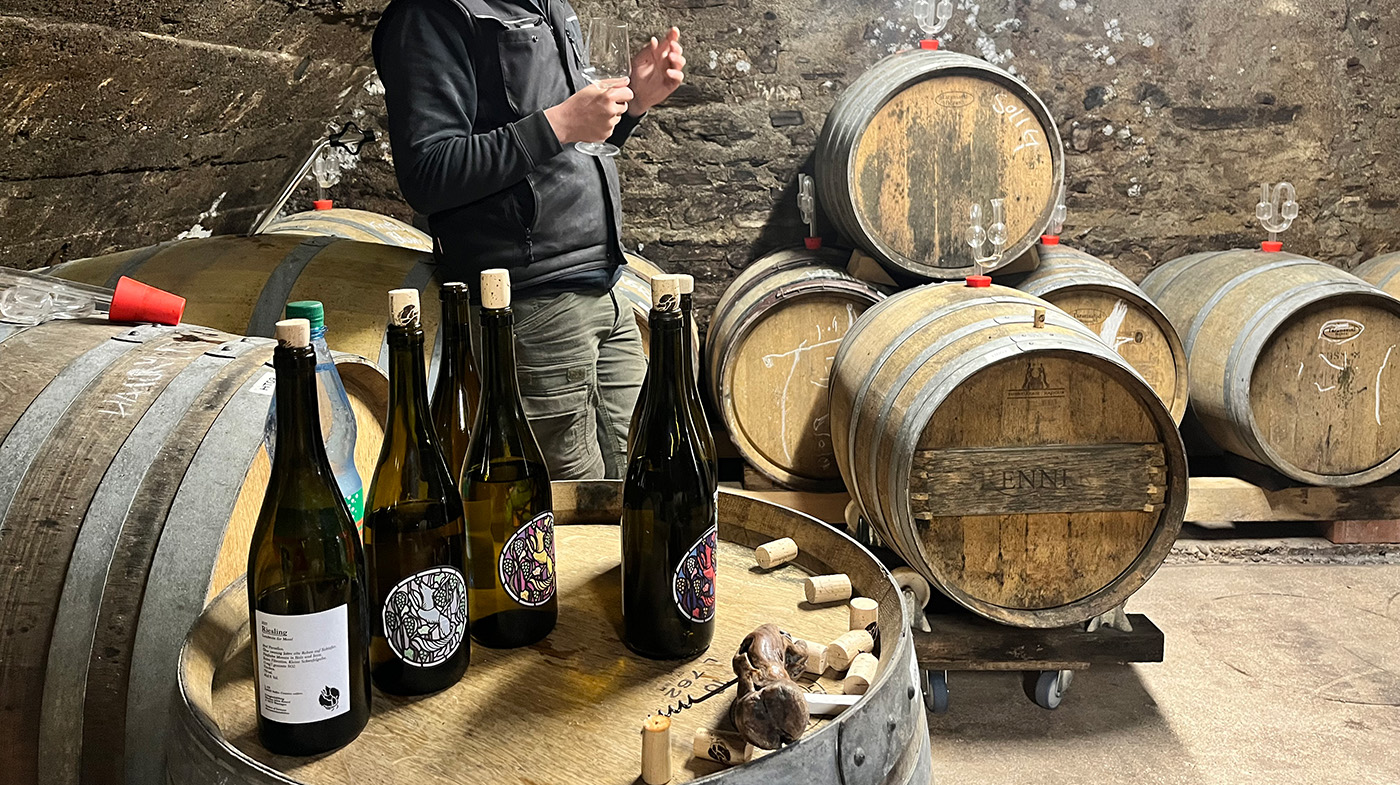
Renard’s signature is wines that are dense and compact, yet they have so much presence, so many layers, so many unique angles and crevices. They are glossy and porcelain-smooth, exquisitely balanced and seamless; they are woven by gossamer threads of citrus oil, mint and salt.
There is a magical play of reduction and oxidation in these wines (in this manner they are very similar to the wines of Jonas Dostert). The extreme inward-looking force of the wines (early picking, high acidity) is pulled outward and sheened into a satiny texture by the extended elevage, the fine lees polishing these wines into ultra-fine textures. Wines like this make it seem as if the Mosel and Rheinhessen and the Jura shared an ancient ancestor.
Maybe they do?