The cold, limestone-riddled center of the Rheinhessen.
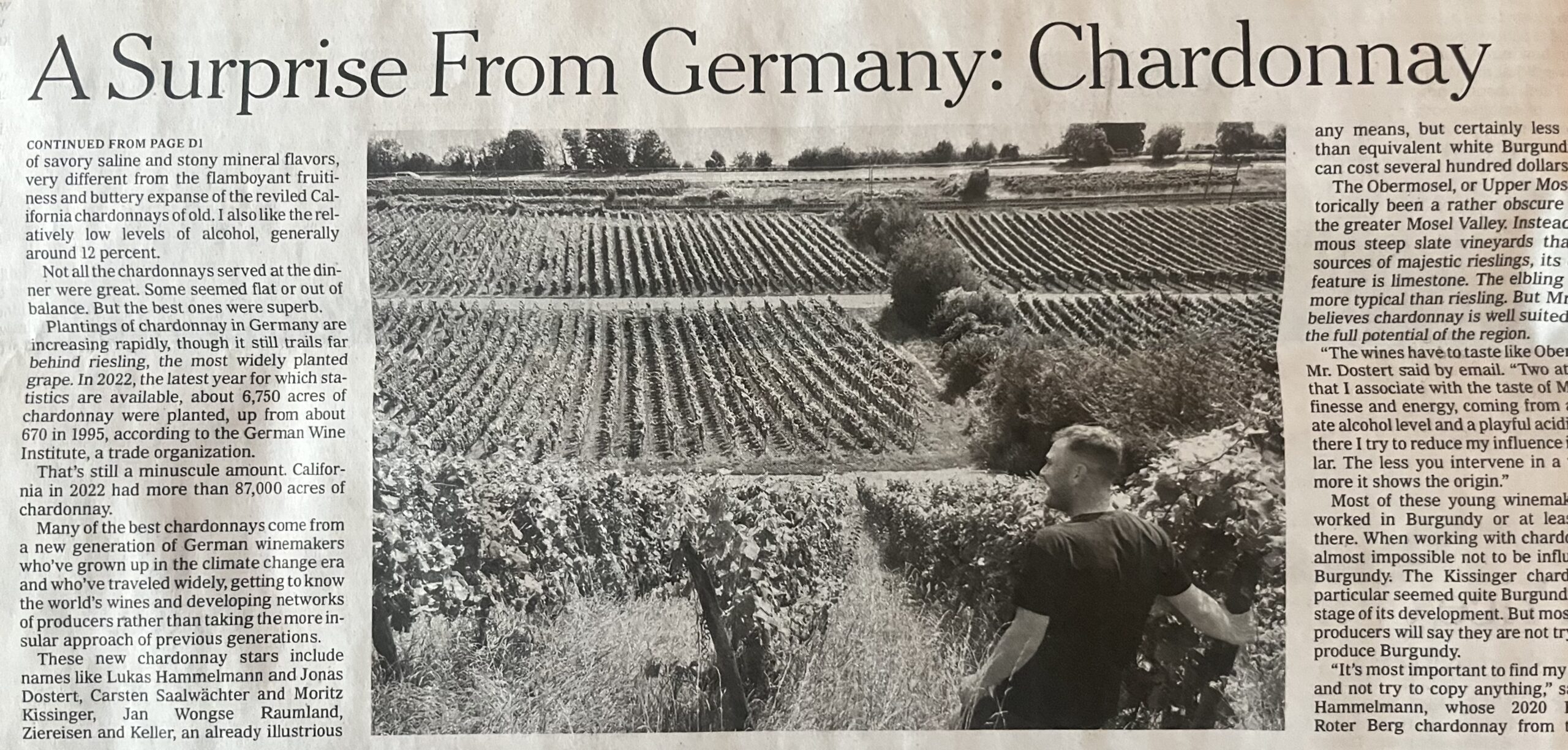
Part of me wants to just write “IYKYK” because the husband-and-wife team of Moritz and Jasmin Kissinger-Bähr have only released a handful of wines and many of them have become something of a phenomenon in Germany.
I will say the amount of emails and IG DMs I’ve gotten about these wines is unprecedented, perhaps only surpassed by inquiries for Keller, which is funny because Keller’s enthusiastic reception of Kissinger’s wines has for sure helped feed the fire in Germany and beyond.
But let’s start at the beginning. These are very hard wines to contextualize, especially as the Rheinhessen has very little context in general.
We’ll do our best to be both complete and concise, to try and explain the hype, the magic and the beauty of these wines.
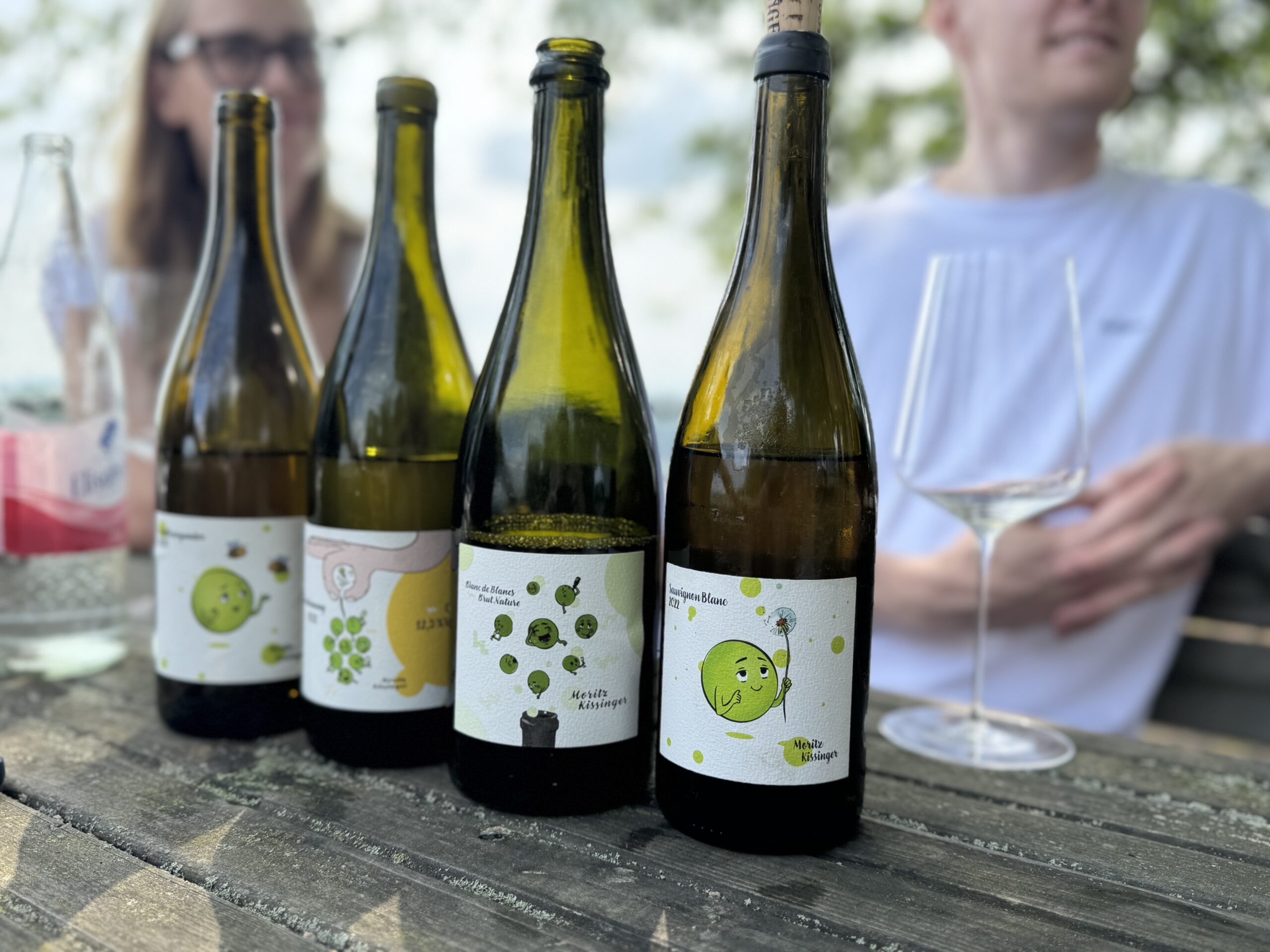
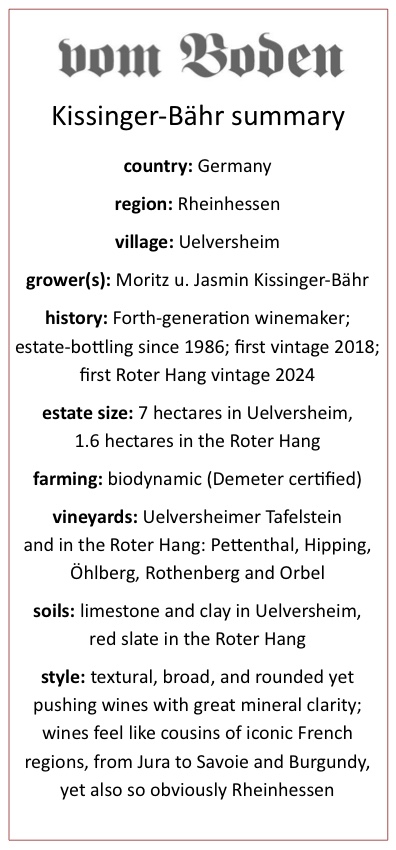
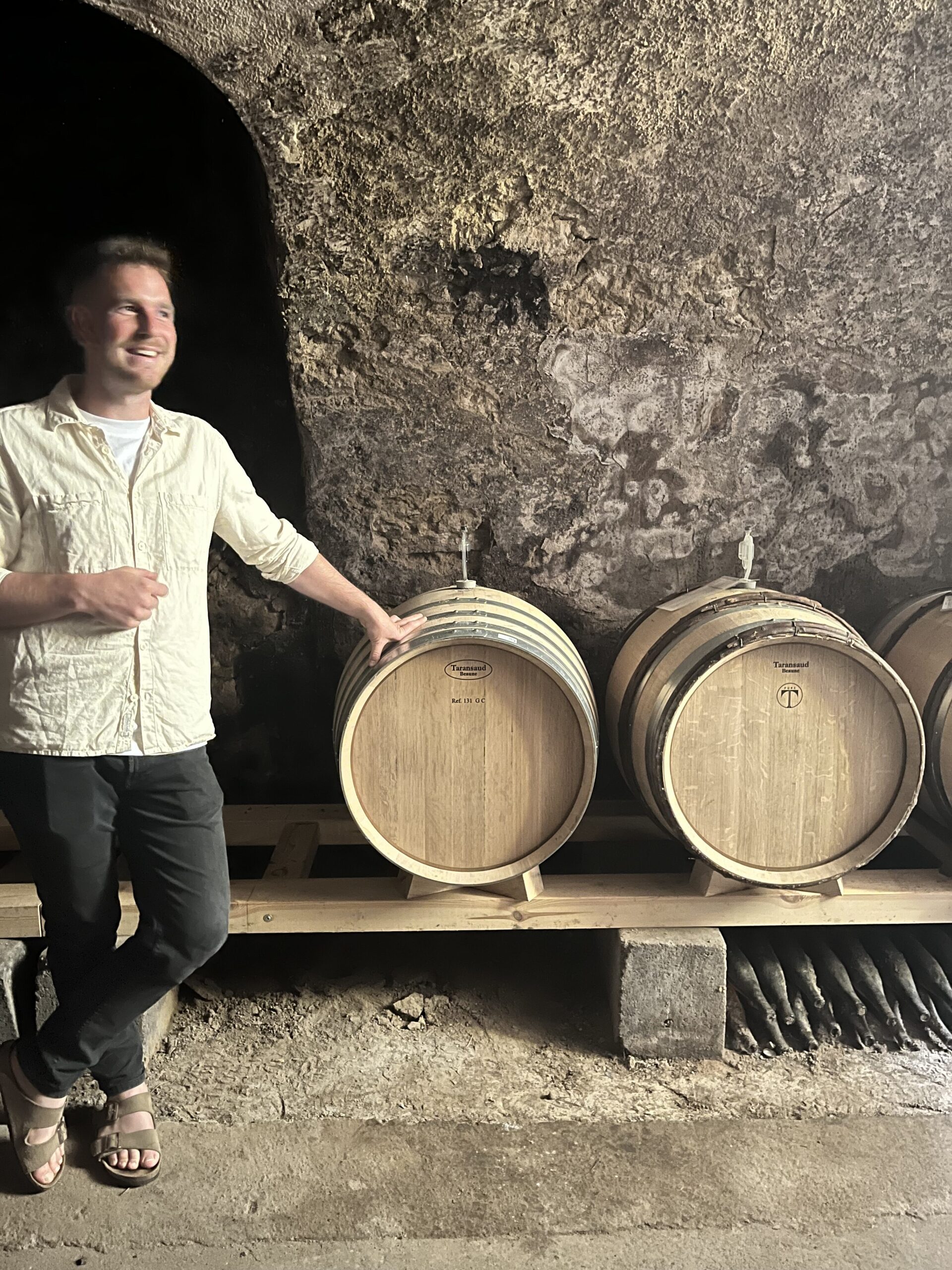
While Moritz is a fourth-generation winemaker, he is only the second generation in his family to bottle his own wines; his father began before him in 1986. While the family estate is about 14 hectares total, Moritz and Jasmin are farming roughly seven hectares in and around Moritz’s hometown of Uelversheim. In 2024 they added a meager 1.6 hectares of vineyards in the Rheinhessen’s fabled “Roter Hang.” At this point, it is probably worth seeing the production here as being two-fold. First, the non-Riesling varieties from the inner-Rheinhessen – this is the bulk of the production and the main thrust of the estate. Second, a tiny, micro-production of Rieslings from the “Roter Hang.” We’ll discuss the wines in this order.
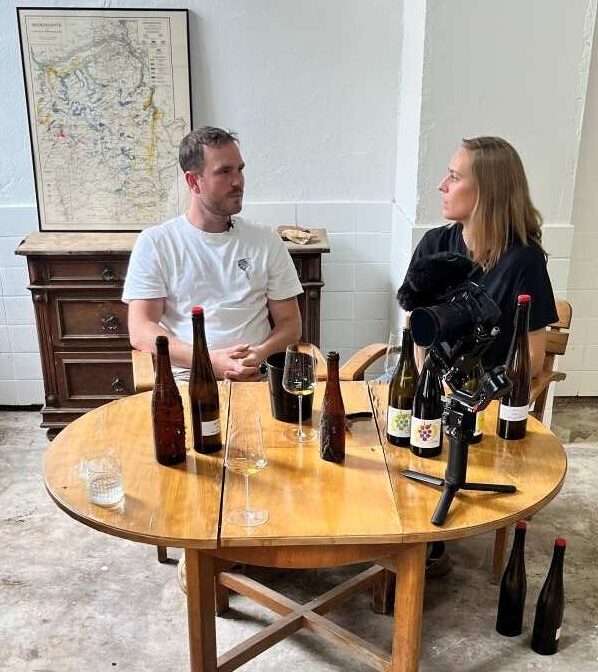
But first, we should say that Moritz and Jasmin, as people, have a warmth and an openness that, like their wines, feels both incredibly refreshing and also somehow familiar – and not in a chummy or cheesy way. Both of them seem to be ever-smiling human combinators – I have rarely visited them without a small entourage of friends from various nooks and crannies of the wine world surrounding them. When I visit them we taste all of their wines… and then normally a parade of wines from around the world – unicorns and trophies, oddballs and curiosities, everything and the kitchen sink. It’s like a vinous version of speed-scrolling through Instagram, sensory data points unfurling across the palate in rapid succession (though this is an analog, human experience, and so one feels none of the guilt after such a tasting).
Moritz has worked with Cedric Mousse and visits Champagne a lot; Burgundy is obviously a passion. Tomoko Kuriyama from Chanterêves posted about Kissinger and we had a little exchange. She wrote to me, “I love the soul and aesthetics of the whites… there’s a warmth and elegance, and on top of all that there’s an effortlessly defined style.”
Suffice it to say that both Mortiz and Jasmin have an incredible energy, a curiosity, a passion and sociability that maybe puts them at the center (or very close to it) of something that really feels like a movement of young growers in the Rheinhessen.
Which is very important, as since the post-war period the Rheinhessen has had something of a schizophrenic history. This, the largest winemaking region in Germany at some 30,000 hectares, was the fertile and fecund ground zero for much of the commercial plonk that devastated the reputation of German wine in the 1970s and 80s.
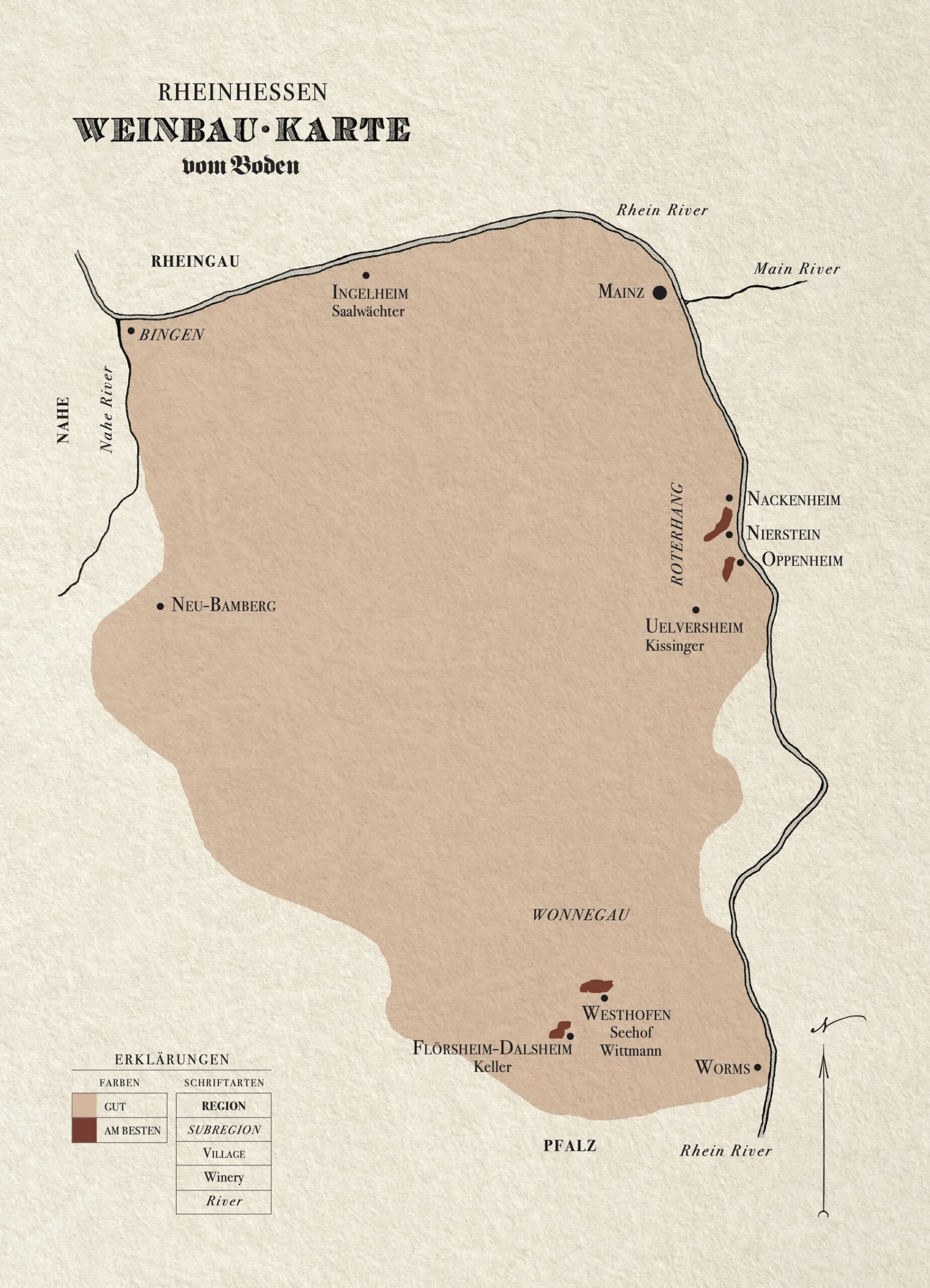
Many of the Kissinger-Bähr vineyards are located in Uelversheim, a village located in the eastern part of central Rheinhessen. Mostly, you would probably define this place by where it is not.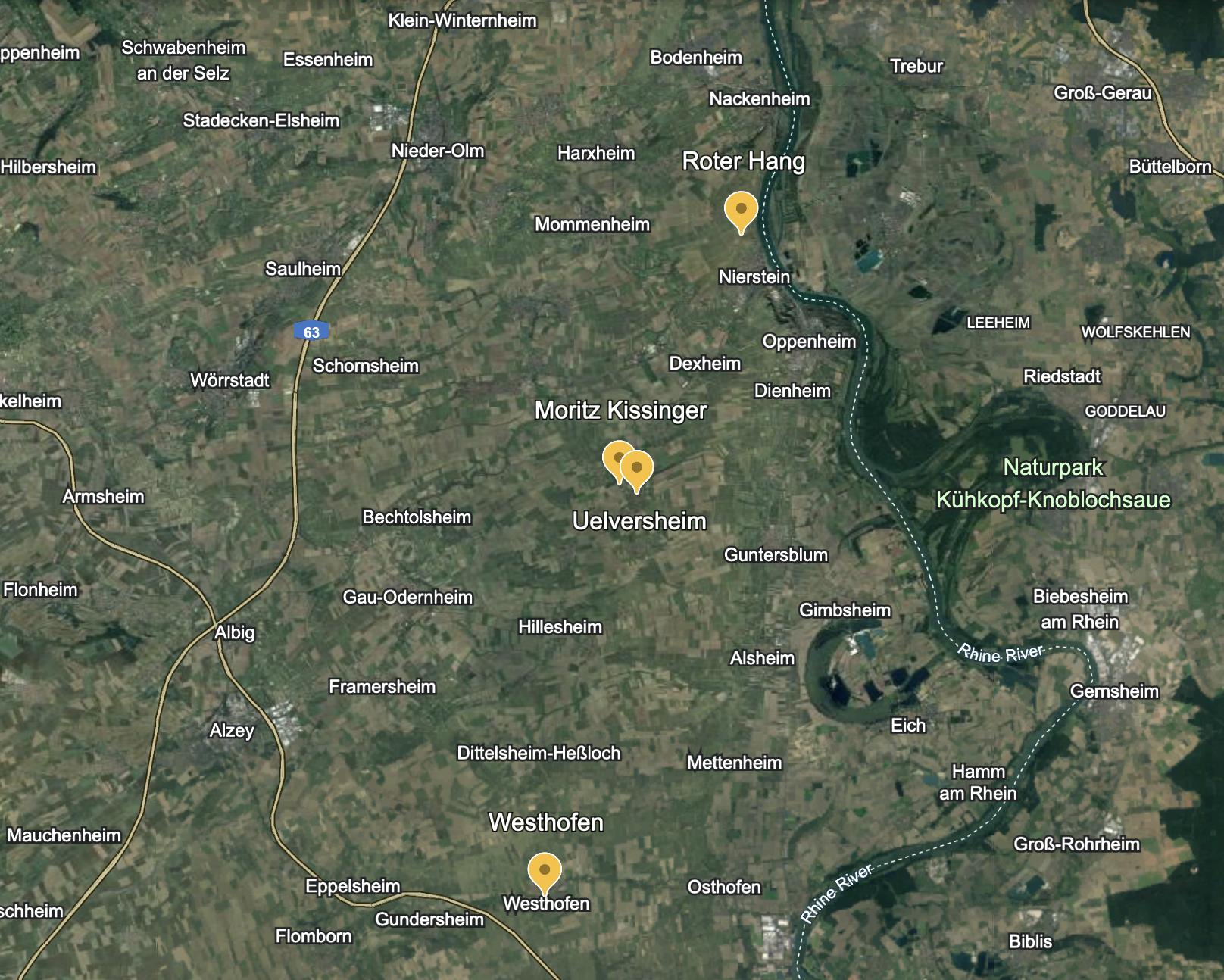 It is not a part of the famed red slope or “Roter Hang,” the steep vineyards hugging the Rhein in the Rheinhessen’s northeast. It is not a part of Keller’s “Hügelland” and the roll-call of famous vineyards around Westhofen. The point being, I suppose, that aside from these two famous sub-regions of the Rheinhessen (which together account for only a few hundred hectares), a fair question to would be: What the hell else is going on in the other 28,000-something hectares of the Rheinhessen?
And truth be told, if you’d have asked me that question five years ago I would have looked at you with translucent, fish-like eyes staring into the blue while trying to think of some respectable-sounding answer… because I had none.
Today, maybe I have an inkling, but the story is only beginning.
Moritz and Jasmin Kissinger-Bähr (and Carsten Saalwächter up in the north of the Rheinhessen) represent for me the two most-realized growers of this “new Rheinhessen.” I’ve been tasting with both estates for years at this point, impressed by their freshman vintages, by the first wines they put into bottle… and now, only a few years later, slack-jawed and oftentimes honestly dumbfounded by how ****ing good these wines are.
I suppose what makes these wines so revelatory is the style, which, when you approach them through the lens of many Rheinhessen wines (most of which are grandiose yet crystalline dry Rieslings), they feel shocking, discombobulating, disorienting. Kissinger-Bähr’s wines are more relaxed, wider. They use their textural qualities in an unapologetic way; they have an approachable honesty that isn’t rustic exactly, but it is maybe jarring – the degree of clarity, the forthrightness.
And then, with the second sip you approach the wines more as Chardonnay or Pinot Blanc (whether still or sparkling) grown on limestone without thinking about the cultural baggage of the Rheinhessen, or of Germany at large, and they make perfect ****ing sense.
These wines are absolutely what they should be.
I’ve had this thought on multiple occasions tasting these wines: “How did no one make wines like this before?”
Dry white wines, and some reds – Weissburgunder (Pinot Blanc), Chardonnay, Sauvignon Blanc, Pinot Noir – that feel simultaneously so original and absolutely obvious and perfect, as if this where the Rheinhessen that has always been around… or should have been. They feel like cousins of iconic French regions and wines – Champagne, Jura, Burgundy – authentically filtered through the soil of the Rheinhessen.
Right now there are little islands of ambitious (and often very young) growers popping up all over the expansive ocean of the Rheinhessen. They are beginning to realize what is to some extent a pretty basic and self-evident fact: Places that were once slightly too cold to get optimal ripeness for the more serious grapes are now in something of a golden zone.
It has been noted by quite a few people that Germany’s climate is today what it was like in Burgundy thirty or forty years ago. For those who are really tasting wines and not trading stocks, this is a profound place to be right now.
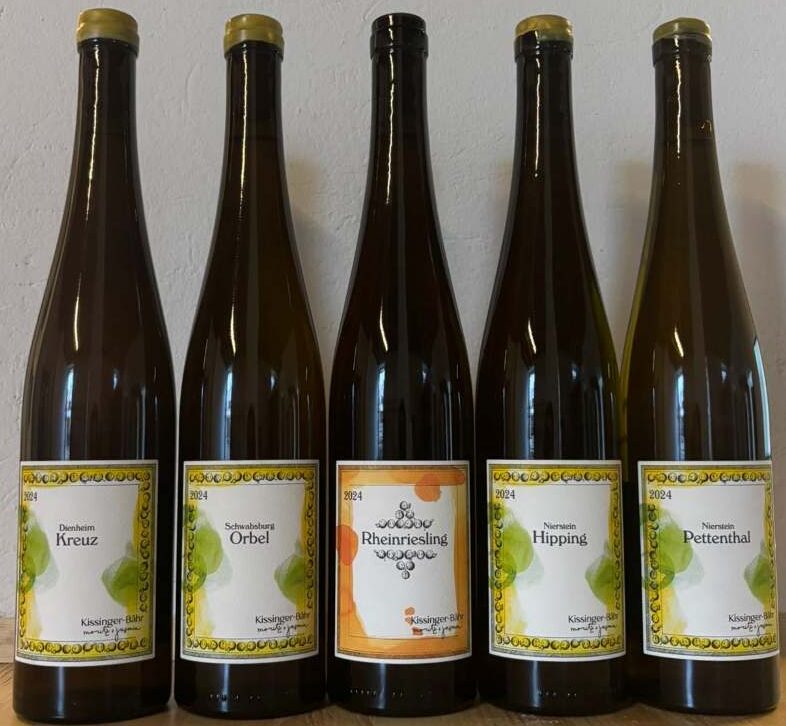
As I noted above, in 2024 Moritz and Jasmin also acquired a number of tiny parcels in some of the most famous single-vineyards of the “Roter Hang,” or “red slope,” including Kreuz, Orbel, Hipping, and Pettenthal. They are now farming, in total, in all of these sites, only 1.6 hectares – so this will remain a very small part of their overall production.
In a way, the two projects – non-Riesling and Riesling – explore two sides of the same coin. If with the former, the non-Riesling wines, they are looking to find the variety, to find the soil, to discover a new possibility for what Sauvignon Blanc or Chardonnay can be in the Rheinhessen, not yet using any of the vineyard names, for the Rieslings they are looking to express the single-vineyards with as much definition and fidelity as is possible.
The former has no history; it is only the present and future. The Rieslings from the Roter Hang have a deep history; they want to bring this narrative forward while being ever-conscious of the past.
We told you this was not a simple story. Yet that’s exactly what makes it so compelling.
Yes, the Rheinhessen is going through a renaissance, and Moritz and Jasmin Kissinger-Bähr are in the very heart of it all.