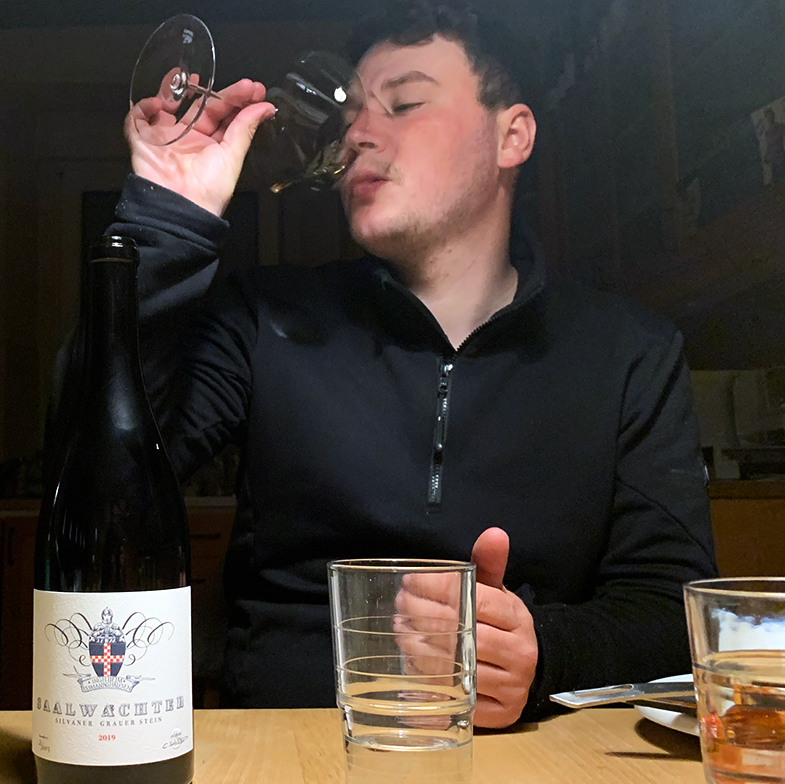
The Coche-Dury of Ingelheim. That’s a joke. Sort of.
Being perfectly honest, I’d say stylistically there are some striking similarities between Saalwächter and Coche: a certain density, ambition, grandiosity in a way, matched to a startling clarity, a startling force and head-turning definition.
On the other hand, obviously the Coche reference is also something of an absurdist stretch. Yet while it’s meant to get your attention, it’s also a very specific feeling I’ve had on numerous occasions, an aesthetic similarity that is there. I’ll leave it at that.
Yet the fact remains that with Carsten’s wines we remain in the very curious situation of wanting to express a very honest opinion, while also (believe it or not) not over-hype-ing or over-selling something.
But the truth is, as we’ve stated before, the feeling we have tasting with Saalwächter is not unlike the feeling we had when we first tasted through the cellar at Wasenhaus. John and I just looked at each other and didn’t even have to say anything. We both knew.
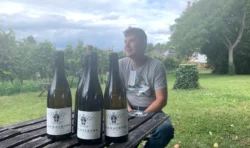
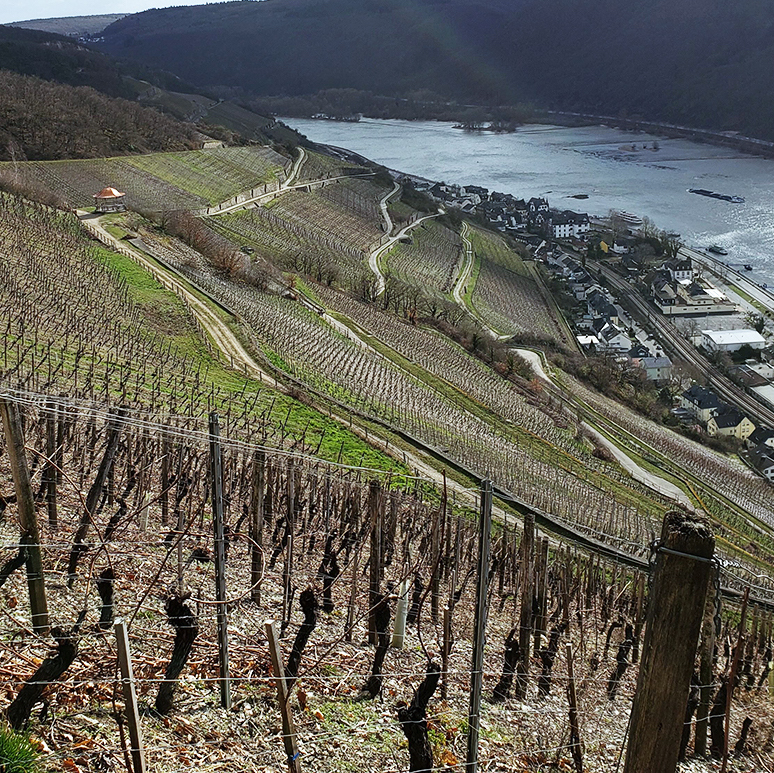
Carsten is farming the limestone-dense soils right in the middle of the cool, northern Rheinhessen – many of the sites are rather flat and wind-swept. Many of the sites even face a bit north, thus giving the wines a whip-smart and forceful acidity, more than enough to counter the pushing fruit and minerality. This a wildly fascinating place with an obvious and immense potential.
Five years ago the only reason I would have been able to say anything at all about Ingelheim was something vague about Charlemagne and his palace? I think it was in Ingelheim where he once looked across the river, saw the snow melting on the slopes of the Rheingau and declared that vines be planted there to enjoy the ample sunlight. Yet now, independently, we have come across two fascinating growers in this place: Carsten and Lena Singer-Fischer. It’s wild.
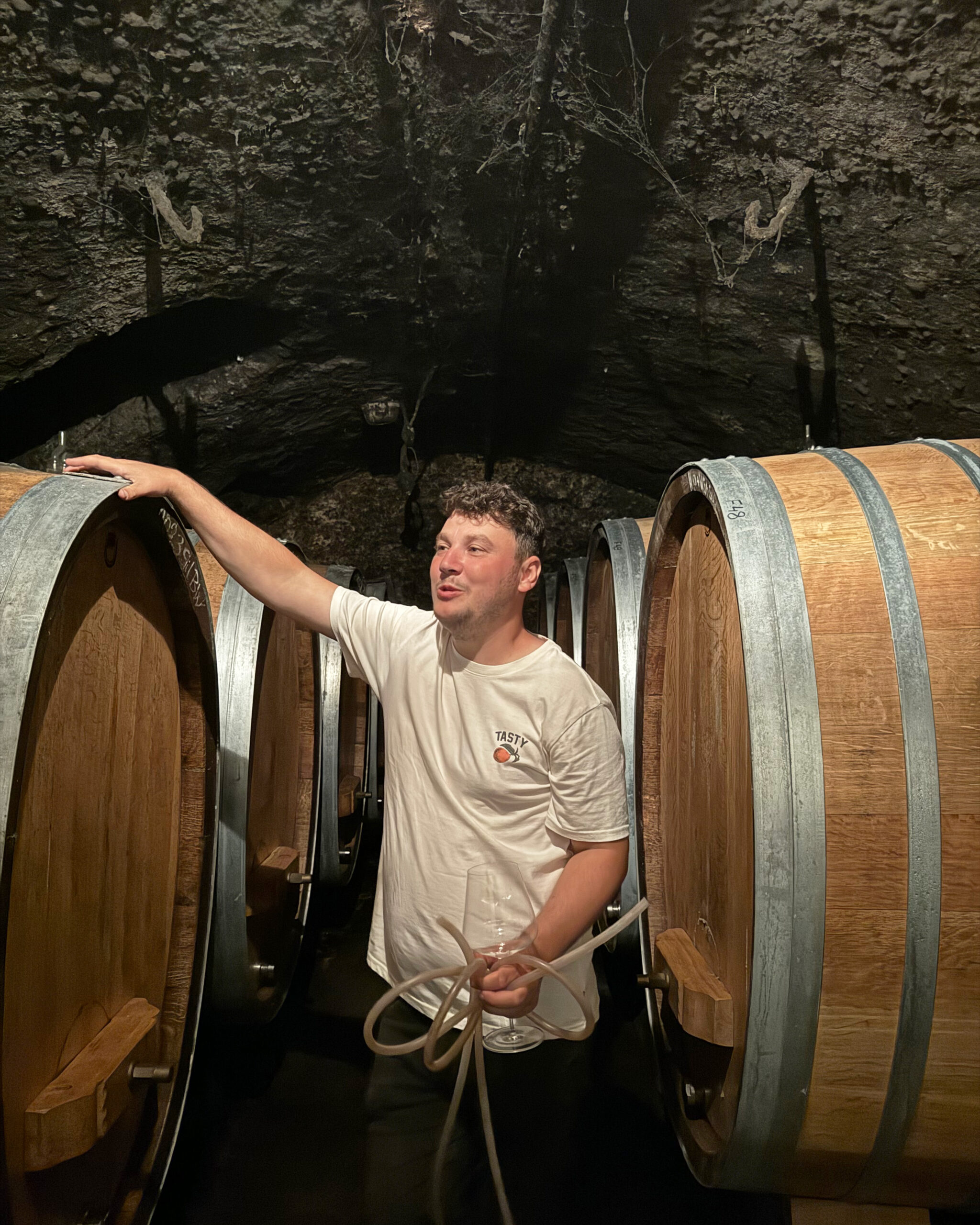
I’m exhausted with writing grower profiles; it doesn’t help that Carsten is very young and still finding his way. So instead of trying to bullshit you, I’m just going to write some reasons I love Carsten.
First: He is psychotically dedicated to Silvaner, a grape that is, in the Rheinhessen, simultaneously a profoundly important part of the viticultural history here and not well thought of. Most growers, with some important exceptions – like Keller – seem to regard Silvaner as that relative that you wish was not a relative. Carsten loves Silvaner. I love Silvaner. That’s maybe the basis of our friendship.
Two: Maybe we aren’t friends? I’m not sure Carsten really even likes me. I like that. I like the fact that he doesn’t in the least kiss up to me, even though I’m his elder and, importantly, could potentially spend a lot of money buying his wines. He doesn’t seem to much care. He has a sensibility that is so relaxed, so calm and cool, that it’s not at all apparent what he likes or dislikes. Is he having fun right now, or fucking miserable? Impossible to tell. On more than one occasion Carsten has reminded me of something of a gangster, straight out of Jersey. You never quite know if the vague smile is a sign of warmth or the kiss of death.
Three: He likes ripeness and warm vintages; he likes to press the **** out of the grapes. Now, I am more a cool-climate guy myself. I like cool vintages, delicate presses, free-run juice, all that shit. But what I like is to hear a winemaker say something that is not inline with what everyone else is saying. Carsten thinks one of his best vintages is 2018. He thinks the phenols he gets by pressing the **** out of the grapes gives the wines structure. What do I know? All I know that his 2018ers are really, really good.
There’s probably more, but that’s all I can think of right now.
In any event, this is an estate to watch.