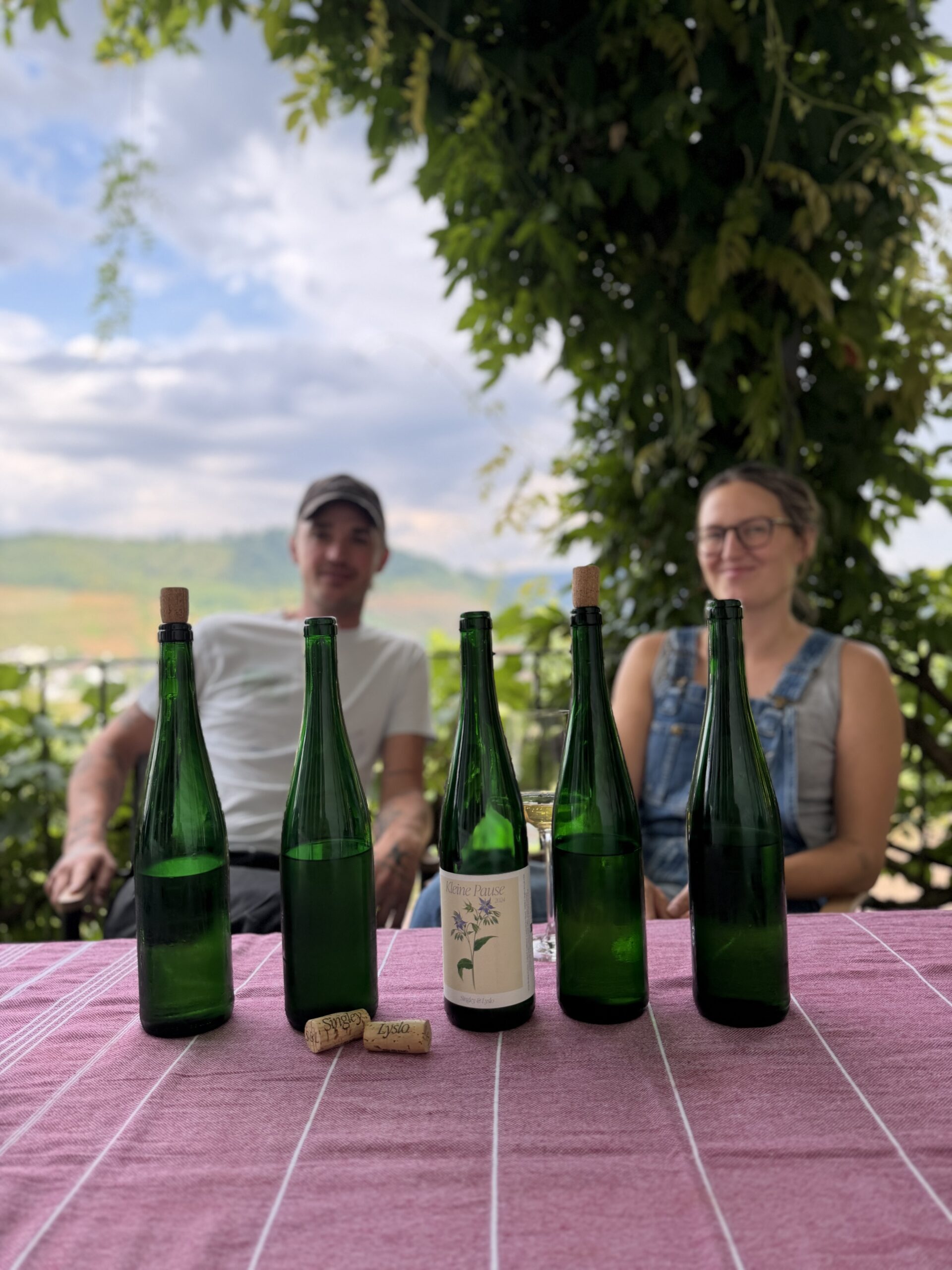
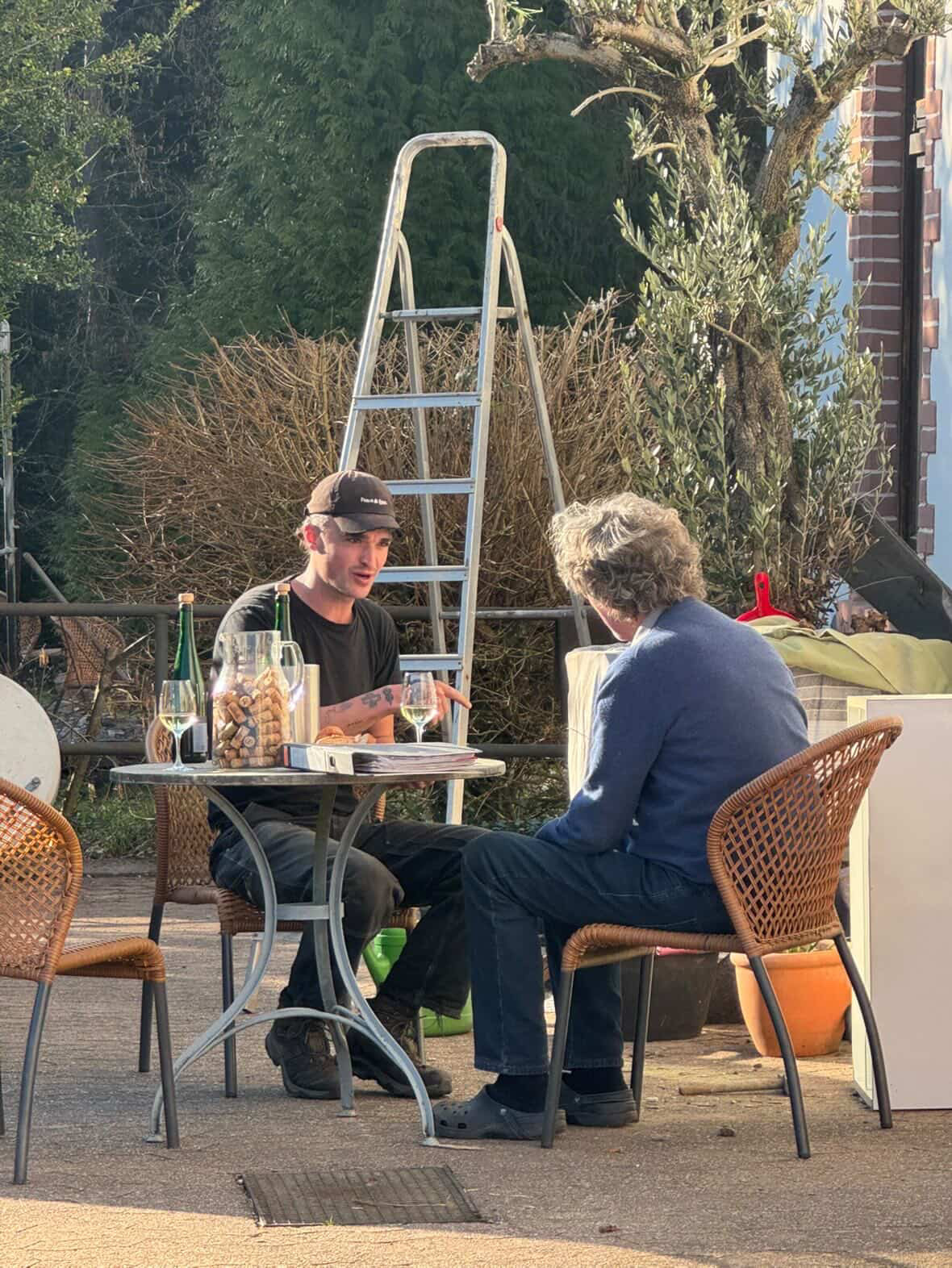
Chad and Megan have been working with Ulli Stein for close to a year now. They are also making their own wine.
What all this means is complicated.
It does seem like they are all thrilled – Ulli, Chad and Megan. It does seem like this was meant to be.
I’ll give myself some credit here, or at least acknowledge my insight, my feeling that Chad and Megan are, somehow, Ulli Stein cosmically replicated by the universe into two thirty-something Americans from Utah and Colorado, respectively. Stranger things have happened?
Let me briefly explain.
Chad has a spirit for adventure, a certain wanderlust, an obvious inner strength and fearlessness which is, or likely could be, intimidating, though he is more prone to hugs and tears than fisticuffs. He has something of what I imagine Jack Kerouac might have had, something that I know the young Dr. Stein had: the sensitivity of a poet, or an artist, which nonetheless does not preclude him from breaking a bottle over someone’s head were it justified. Before finding the Mosel, Chad spent years fishing in the rough north Atlantic seas and he has, let us acknowledge, some stories.
And Megan, Megan is something of Stein’s intellectual curiosity, made manifest. Megan got an undergrad degree in biochemistry before studying winemaking at U.C. Davis. Stein, as I think we all know by now, got a degree in winemaking and then went on to get his PhD in plant biology. In a truly bizarre twist of fate, Megan had tasted some of Stein’s wines in 2020 and when she found out he was a biologist, she emailed him asking if he might have any sort of apprenticeship open. Stein, though brilliant, is not overly concerned with what we might traditionally call “organization” – the email was lost in the interweb.
Regardless, the universe made it happen. And now we have Stein as the rebel in Chad; Stein as the scientist and intellectual in Megan.
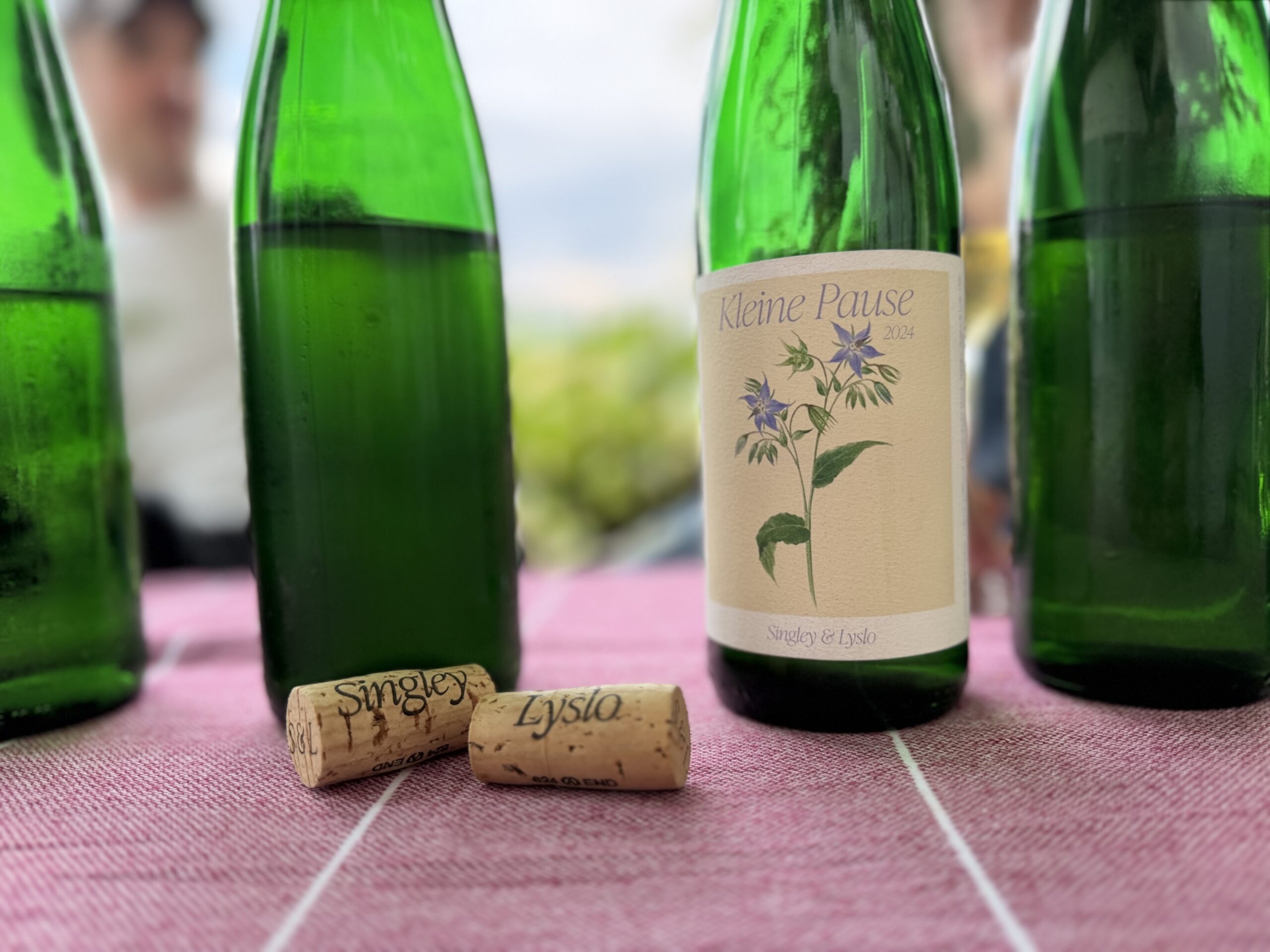
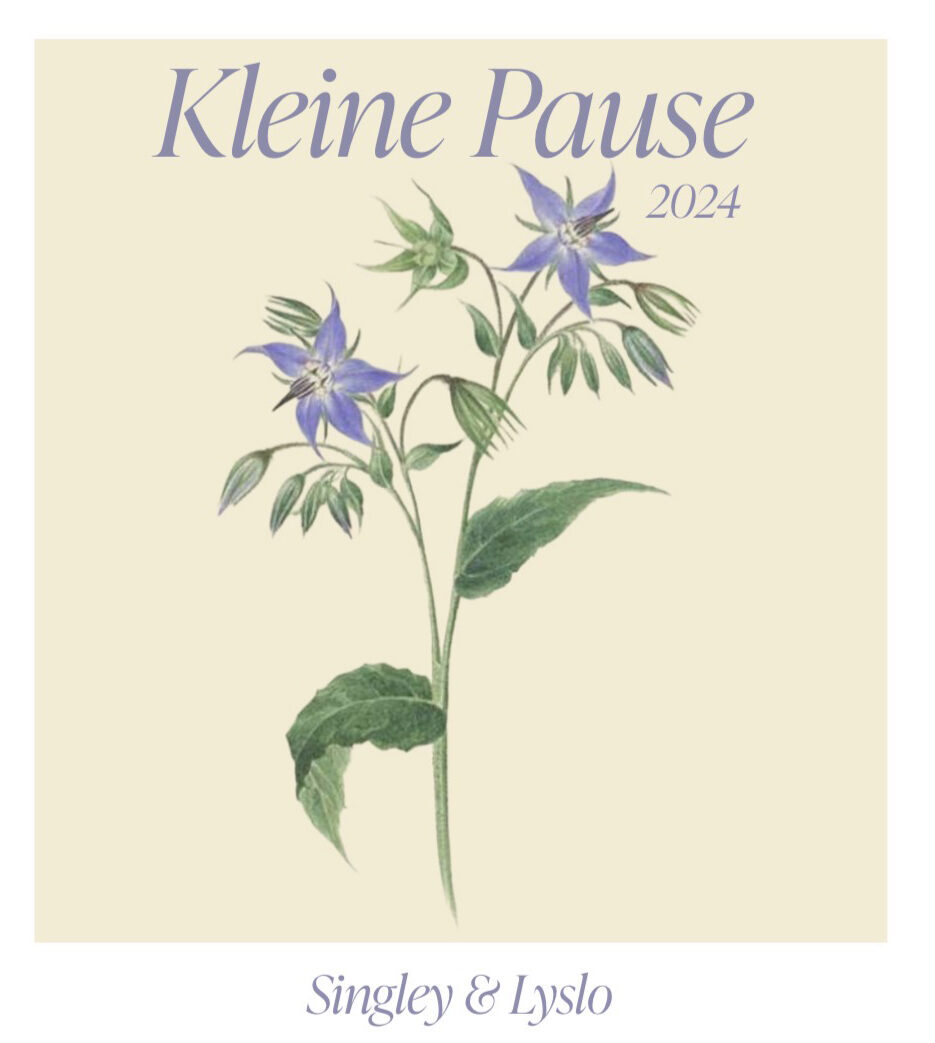
Yet the story of how they may weave themselves into Weingut Stein is a tale for another time. For the moment, I want to talk about the tiny amounts of wine they are making on their own: a project humbly called “Singley & Lyslo.”
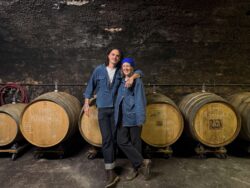
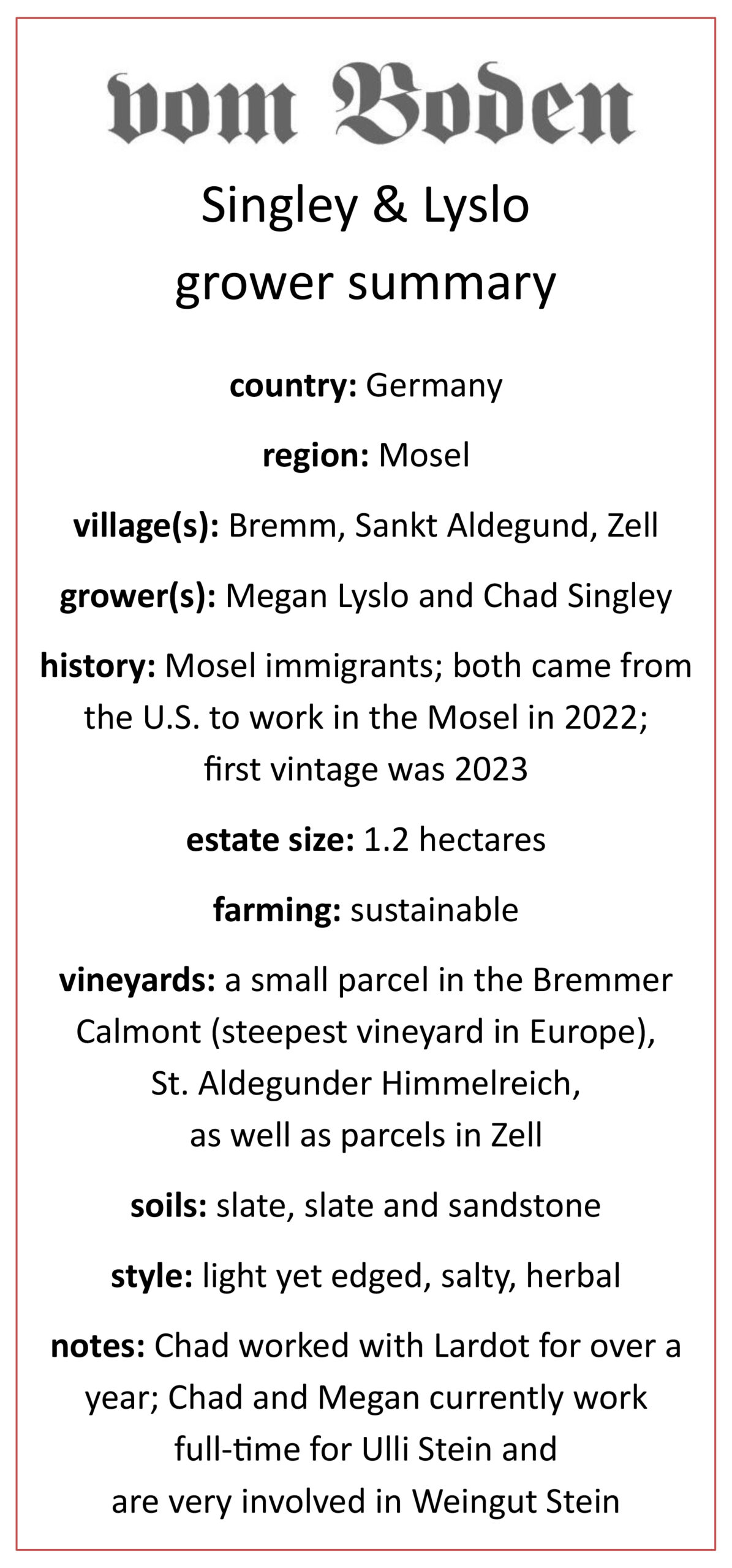
Megan and Chad are working a small and curious collections of vineyards – just over one hectare total(!) – from Zell down to Bremm, including the Zeller Kreuzlay, St. Aldegunder Himmelreich, and Bremmer Calmont (famously the steepest vineyard in Europe). Before working with Stein, Chad worked with Rosa and Philip Lardot (Chad was, in fact, the officiant at their wedding, thus my knowledge of his tendency towards hugs and tears), and so it makes sense that the tiny parcels they are working are essentially either Lardot- or Stein-adjacent.
The style I would say also floats in this general register, somewhere between Lardot and Stein. As at Lardot, after fermentation the wines are aged in smaller, neutral barrels (pictured above) and allowed to go through malolactic. As such, they are most often dry, and have a savory, herbal quality that is, for me, the essence of the Mosel. These are Moselles.
Yet Chad and Megan are also exploring styles, flavors, production methods. For example, one wine’s fermentation slowed down, leaving it with some residual sugar, and they were both taken by the wine. It will be filtered and bottled as a Kabinett. So if the general aesthetic leans more toward what I’d call the “neue Moselle,” they have something of the playful curiosity of Stein, who has spent the last half-century defending traditions only to then upend them.
Importantly, with Stein, Lardot, and many of the growers we work with, their work is, literally, saving the Mosel. They are working old vines on even older terraces. Many of these sites would simply go fallow, were it not for their labor.
For that, and for the wines, I am grateful. I’m also excited to see how this story develops.