
Alexandra Künstler of Weiser-Künstler smiling in the Ellergrub, April 2026
Einleitung | introduction
The world is a confusing place right now. The best thing to do, I’m sure, is to put down the phone and walk outside.
I mean, look at Alexandra Künstler’s angelic smile, above. There is goodness in the world, we all know it.
I have to believe that if a certain type of digital, algorithm-based deluge of content that destroys its own meaning by its being unending is the general status of things, it stands to reason that a desire for things that are sincere, real, and limited will rise among us.
If we are only now beginning to understand just how far we have been pulled away from our most basic humanity, it stands to reason that a desire for things that bring physical human bodies together, things that return us to age-old traditions and our most basic humanity, will rise up among us.
At the crudest level, this is what wine does. It is not new. It is in fact very old. It is analogue, like breathing, or walking. It is natural, slow, inconsistent. It is quirky, mysterious, spiritual, banal, delicious, inefficient, silly, comforting.
It is social.
If Robert Putnam’s devastating book Bowling Alone is a treatise on our modern society, it’s worth noting that most people, most of the time, drink wine together.
And because of this most basic of facts, I think to myself: There is reason to hope.
With that, I want to once again firmly sew our hearts onto our sleeves, in case you hadn’t noticed already: Germany, and the culture of German wine, is our overriding purpose and passion. Unwisely, as any financial advisor would tell you, we have not diversified.
We hope this vintage report is of some use; we hope the fuller context of German viticulture, the work we do every day focusing on Germany, offers you value. We hope, verily, that when you think of German wine, you think of us and our growers… and you support our growers.
The truth is we have no Sancerre to sell, no BTG-able Chianti. We have nothing else to fall back onto.
This extreme focus is a huge advantage, I think…. but it is also a huge liability.
Thank you. As always, with any questions whatsoever, we (a real human and not an autoresponder) are here: orders@vomboden.com
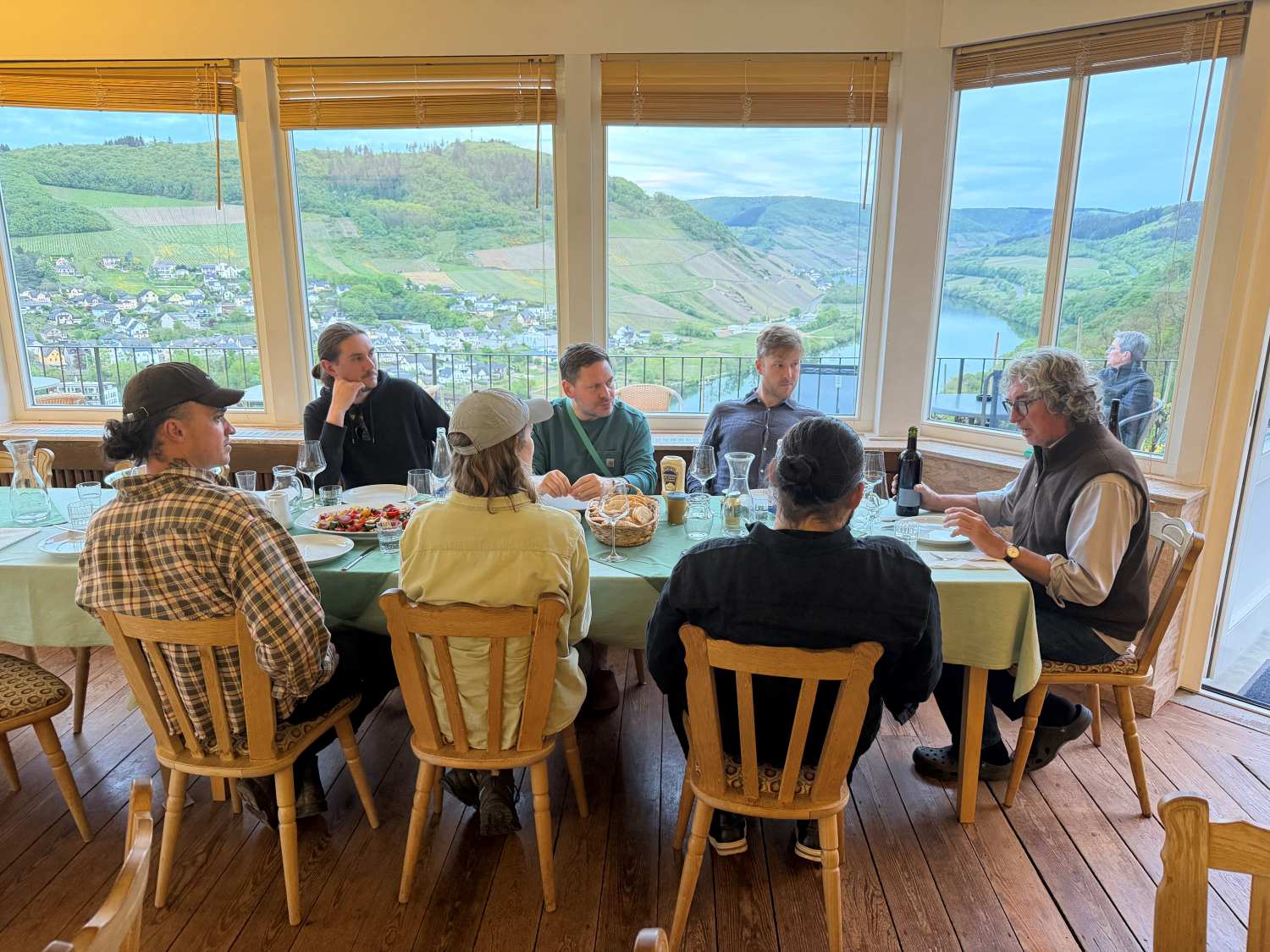
Haus Waldfrieden on top of the magic mountain with the good Doctor Ulrich “Ulli” Stein and a background that looks AI generated, but it is most definitely not, April 2026
die Weine | the wines – summary
Most often, as I begin to write, I take a few moments to review the vintage reports of yore. It’s sentimental, very often humbling, occasionally gratifying, sometimes even rewarding. But most of the time I think to myself: Sweet Jesus you really had this much to say? Part of me wonders if I’m paying myself by the word. Am I the assigned author, the editor asleep on the job, and the accounts payable department, all in one? That’s a dangerous brew.
This year I’m going to try and keep this more focused, which is to say shorter.
So how’s this: Vintage 2025 is really fucking good.*
* With one important caveat: this is true only for those growers were able to harvest nearly everything – or at least their critical parcels – before the rains.
In a way, I have a very selective view of the 2025 vintage, making my rounds and tasting with perhaps the 30 to 40 best and smallest producers in Germany. Their vintage is perhaps not the same as the vintage of many of the larger estates that could not get everything done in time. While I didn’t taste any, I have heard stories of wines with much softer acidities, more luscious textures. 2025 with its early start and ultra-compressed timeline is perhaps a tale of two vintages, for all the reasons I’ve outlined in my essay “The Vintage Report is Dead: On Scale, Labor, and Heat.”
Yet, at least among my squad, I can almost guarantee you are going to like the wines of this vintage, probably a lot, because there is enough fruit, perfume, heft, and texture for the more “normie” drinker, yet also superb balance, an effusive, almost bouncy energy, a firmness.
The small-grower wines of 2025 tend to have a lovely ripeness – it’s there, but not too much – but then there is a firm structure – it’s there, but not too much. The joyous balance of nearly all the wines is just easy, simple, and yes, great. In most cases ripeness levels are higher than they were in 2024, which is not surprising, 2024 being a rather cool vintage. But they are not in most cases super high – many of the basic dry Rieslings of the Mosel clock in at around 11% alcohol. There is ripeness, but it is not necessarily expressed through alcohol or power.
What is even more interesting is that in certain cases the acidity levels of 2025 are also higher than they were in 2024. I asked nearly all of the growers about this and most just sorta shrugged their shoulders. It’s complicated.
For many growers, especially those in the Rheinhessen, Pfalz, Württemberg, and places south, one of the primary reasons for these strong acids was the smaller harvest, the lower yields. These small(er) yields were the results of a few things: a complicated flowering, isolated frosts and a bit of hail here and there, depending on your specific geography. Lukas Hammelmann in the Pfalz got hit and made only one barrel of Pinot Noir. Keller reported the lowest overall yields at the estate, ever. But many growers also had quite small berries with thicker skins and this will nearly always translate into higher acidities. So less… but better?
While the summer was warm, August had plenty of cool/cold nights which also helped to preserve this acidity in many cases.
Regardless of the exact reason for each grower, this rigorous acidity is noticeable, even peculiar. Even when inexplicable, the growers were thankful.
Now, we play the vintage-comparison game every year. It’s mandatory, sort of like saying, “Hey, how’s it going?” when you come across a friend, even though you’re standing right in front of said friend and you can sure as shit see for yourself “how it’s going.”
Most years I grill the growers. I make complex Venn diagrams. I try and find some elusive insight, something that will keep people coming back for more.
This year, basically everyone said: “2025 reminds me of 2015.”
Then I tasted the wine and I thought: “This vintage reminds me of 2015.”
Honestly, in ten-plus years of playing this game, this was the most obvious, easiest year ever. It almost wasn’t even fun. (As a side note, we held a tasting of some newly arrived 2025ers in New York in early June and as both a gimmick and an honest investigation, I opened four different 2015ers from my cellar. It was wild. The comparison holds very well.)
No, it’s not exactly the same, obviously. It’s hard to say but it could be that 2025 feels a bit lighter than 2015 did out of the gate? It could be that it feels like it’s threaded with the compactness and energy of 2019 – just a touch more lift? It could be that this perception is influenced more by the youth of 2025 than by any essential difference, only time will tell.
The wines are really beautifully balanced and I think they’ll age amazingly as well, much like 2015.
I know, many of you are rolling your eyes. It’s almost a joke: Another great year, really? But what can I do? Honestly I went to Germany this year (twice in fact) and both times expected to be a bit disappointed. It was a warm year, a ripe vintage. The harvest was difficult.
None of these things normally align with my aesthetic vision of what German wine is, or should be. I figured the gods of German wine had given me 2021 and 2024 quite recently, what did I expect? Am I really that special? I already have so much to be grateful for. If I have to put up with a few “ok” vintages, so be it.
I’m sure I’ll have to deal with this and more, at some point. But not now. Not for vintage 2025 in Germany.

Absolutely every day in 2025 looked exactly like this: perfect in every way – July 2025 in Vollenweider’s Goldgrube.
das Wetter | the weather
I’m going to try and be *very* concise here.
If there is anything more boring than trying to summarize the average temperature, rainfall, humidity, and general weather patterns all across Germany’s grape growing regions, I haven’t come across it. Maybe bond yields?
The story of vintage 2025 is both unexceptional in most ways and in a few ways exceptional. It was unexceptional in that it was a mild winter. After the frost-trauma of 2024, there were no serious problems. Yes, some growers experienced a complicated flowering, there were frosts and isolated incidences of hail, but all in all this was all well within the range of normal – or at least of what we now think of as normal. As mentioned above, yields were quite small in the Rheinhessen (overall down 23% compared to the ten-year average), the Pfalz, Württemberg, Baden, and the Nahe. While the Mosel and Saar had fairly normal harvests, the low averages of most appellations makes 2025 the smallest vintage in Germany since 2010. I guess that’s exceptional? That tale of two vintages thing again?
Whatever was happening on the ground in Germany, however, it was happening early, as is I guess unexceptional these days. Some growers compared the situation in the early summer to 2018, at least in terms of the early start and warm weather. As in 2018, an early harvest was predicted. A bunch of us from vom Boden were in Germany for a week last summer. I was there for most of June and it was warm, for sure, but still cool in the evenings.
August is where things changed; it became quite cold, and then, quite rainy.
Here is where 2025 begins to wildly diverge from 2018, which had warm-to-hot August days and (importantly) warm August nights. I spoke to Ulli Stein toward the end of August and he said many of the nights in the Mosel had been in the mid-40s Fahrenheit through August. That’s cool.
And then in September things got, well, rainy.
Depending on where you were the rain came either sooner (Mosel) or later (Rheinhessen and parts south). In a way, as I mentioned above, 2025 is a tale of two harvests: one before the rains, and one after.
While it was not easy, most of our small growers didn’t seem too traumatized by it. A number of factors helped to alleviate the potential for serious hand-wringing.
First, most growers knew this was going to be an early harvest. If growers ten years ago often went on vacation in August, that is becoming less and less the case. August is prep time.
Second, most growers knew the rains were coming in September and they could prepare the vineyards by pre-harvesting – removing fruit that wasn’t top-top, so that the remaining fruit had more air circulation. In other words, they were prepared.
Three, most growers are by now quite aware that the entire concept of “the harvest” is being ever-more condensed.
The vintage 2025 distinguishes itself as being both among the earliest harvests ever (this may be another factor explaining the piquant acidities) as well as among the fastest harvests ever. Again the small growers have the big advantage here.
In the Mosel, Julian and Nadine Haart began on September 5th (for Pinot Noir) and ended on September 25th. (The Riesling harvest at Haart began on September 14th. Only eleven days long. Jesus.)
Emrich-Schönleber in the Nahe began on September 9th and ended on October 2nd.
Seehof in the Rheinhessen began on the 4th of September and ended on September 22nd.
Lukas Hammelmann in the Pfalz began on August 24th (for sparkling wines) and finished, break-neck-style, on September 14th.
Wasenhaus in Baden began in the final days of August (for sparkling wines) but then from September 4th to September 20th the real action unfolded with their still wines.
Only our resident rebel, Ulli Stein, offered us a narrative of the harvest going deeper into October. He is the only grower we represent that I know harvested significant quantities after the rains in the Mosel. Contrary to what you might think (to what I assumed), the wines are arrow-like and vigorous. It’s sort of insane. I’ll have to write a separate vintage report called something like: “Ulli Stein and the vintage that whispered secrets only to him.” To be honest, as of this writing, I’m not 100% sure how Ulli managed this. Then again, for close to 20 years I’ve been unsure exactly how Ulli manages everything. He is his own force.
die Weine | the wines – our new system
In reviewing the wines, going forward, we are going to have three rough categories.
We’ll discuss the basic dry Riesling and Prädikat Rieslings of the new vintage – in this case the 2025ers. We’ll offer preliminary thoughts on the “Grand Cru” dry Rieslings of the vintage, but more and more this just feels foolish. These wines need at least a year post-vintage to really even begin to reveal themselves.
So, to correct this fact, we will begin to write a bit more about the “Grand Cru” dry Rieslings of the previous year – in this case that would be the 2024ers.
Finally, as the amount of German wine grows that isn’t bottled until later in the year post-harvest, or even in the spring of the following year, we will review these separately. These can be Rieslings (such as from Philip Lardot or Julien Renard), but mostly we are talking about wines made from Silvaner, Weissburgunder, Chardonnay, and Pinot Noir, to name just the most obvious. I suspect Pinot Noir, and the red wine vintage in Germany, will become a more and more important part of these reports.
We just want to be more honest to the growing complexity of German viticulture.
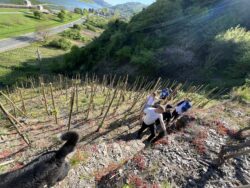
Up in the dramatic terraces of Rosa and Philip Lardot’s Himmelreich vineyard – look for the “am Bach” bottling – April, 2026
die Weine | the wines – 2025 basic dry Rieslings and Prädikat Rieslings
Damn I had so much to say last year and this year, I don’t know.
Maybe the problem is that the wines just sort of have everything, in lovely proportions. It’s the sort of vintage you want to tag with some superlative, but choosing the superlative is really tough. Exuberant? Perfumed? Succulent? The word “great” works, but it’s too generic.
This is a vintage that is honestly so clearly above average, that it’s hard to pin-point, exactly, what makes them feel so good. I guess let’s try and get a bit more specific?
The basic dry wines are superb – and by that I mean, superb. Across the board these wines are just so effusive with everything you could want from a dry Riesling. I’d add that while they are all gushing and friendly, they retain freshness, focus, and a sense of place. I mentioned the tasting we had in New York in early June. It was my third time being able to taste the basic lineup (my first time in the U.S.) from the Rheinhessen (Seehof) and the Mosel (Haart, Max Kilburg, Weiser-Künstler) and the Saar (Lauer) and they each felt different in an appropriate way.
The vintage theme of having something for everyone – from basic drinker to dork-enthusiast – rings true here. All the wines are effusive, floral, though not heavy, and not strict, but still firm. But it could be that the “estate dry” is one of the sweet spots of the vintage? They might drink a bit more serious than your average entry-level wine. What can I say: I know I was exceedingly happy drinking these basic dry wines.
The feinherb wines of the vintage also feel like a strength. Those that harvested early enough were able to retain, as said, a fairly tensile acidity in the finished wines. The best feinherbs have absolutely no problem countering and lifting the heady fruit and florality.
There are some bonkers Kabinetts: The collection at Vollenweider is so angry it’s thrilling. (Question: Can acidity have tannins?) The young Max Kilburg has maybe pushed the envelope further than most, with a Kabinett collection that is dazzlingly light and tense. I have to check my notes: This was a warmer vintage, right? It does not taste that way at Kilburg. The same could be said of the young Julian Ludes, where the collection is a tour-de-force of dry-tasting, feinherb, and the rare(r), truly off-dry Kabinett.
Julian and Nadine Haart, Lauer, and Weiser-Künstler are simply masters of the Kabinett. It is their stage. And they do not disappoint in 2025.
Yet as triumphant as these wines are, these wines are neither particularly plentiful, nor does it feel like they are the soul or signature of the vintage. My best guess is that the top, top expressions of the vintage will be either the Grand Cru dry wines (we’ll say more about this, I guess, next year?), or the higher Prädikats (meaning Auslesen mostly) which of course you don’t care about, unless you are Matt Turner at Lei wine bar in New York City. Be careful: He will fight you if you talk shit about Spätlese or Auslese.
Weiser-Künstler bottled no fewer than four different Auslese and they are all so different and glorious and special. These are wines I want to protect dearly, even though I know there won’t be many people coming for them.
The lineup at Emrich-Schönleber is superb; they do what they do. They are so damn linear, so incisive and penetrating. The basic Estate is delightful, though the “Mineral” earns its heralded position in the market in 2025. Hot damn.
We’ll see on the Grand Cru dry Rieslings; I have a sense they will be – at some addresses – maybe the top wines of the vintage. But let’s see.
I’d add that 2025 may prove to reveal, over the course of time, a differential between the areas in the Mosel-Saar-Ruwer (that’s right German wine law, **** you, look, I’m using the forbidden appellation) that had normal to good yields, and the small-berried, very-low yields from the south, including the Rheinhessen, Pfalz, Baden, and Württemberg. Many of the growers in these places do seem to have even more super-charged acids. Young wines nearly always have a certain buoyancy, a freshness and lift. So while it’s difficult to perceive right now, it’ll be interesting to revisit in a decade or so.
I’m already looking forward to that honestly.

Matt T. asks Florian Lauer the difference between “Kabinett Halb-Spät” and “Auslese Kabinett Feinherb” in the Schonfels, April 2026
die Weine | the wines – 2024 Grand Cru Dry Rieslings
Why it is that a Kabinett Trocken reveals itself, to some degree, in the spring following the harvest and a “GG” or Spätlese or Auslese Trocken takes another year to say anything? Honestly, I don’t know.
But I do know this is the case.
And so here, in the spring of 2026, it feels beyond foolish to comment on the Grand Cru dry Rieslings of 2025. They are just too young; most are still in barrels, still on the lees. Most estates won’t be bottling them until the summer (at earliest); others won’t bottle until after the harvest. Most estates really won’t be releasing them until the fall of this year anyway; we try every year to delay as much as we can the actual sale of the wines until the winter of the following year.
So, we’ll talk about the Grand Cru dry Rieslings of 2025 next year. Now let’s talk about the 2024 releases?
It would probably be worth a quick review of our 2024 vintage. I called our report “Beauty, Classicism, and Nostalgia” because it was a cool vintage that presented more classically scaled wines. For me, they spoke of a time since past, though as easy as the vintage game was for 2025, in 2024 it was totally confusing.
Regardless, the wines are, for me, stunning, brisk, dainty even, yet so alive and cool-toned and mineral.
The collectors and enthusiasts will be in rapture; the general white wine drinker will wonder what the hell all the fuss is. That’s fine, honestly. Because of the frosts, the quantities are very small.
Because things are, in general, a bit cooler as you go north, the dry wines of the Moselle can be on the sharp side: Haart, Lauer, Weiser-Künstler, Vollenweider, Stein. In the Nahe Emrich-Schönleber, holy ****. I love, love, love, LOVE them – but maybe they are not for everyone?
As we head south, or east, things stay tensile yet there is more glycerin, more fruit, more obvious pleasure. Keller and Seehof nailed it, as did our friends in the Pfalz and even in parts south.
That said, I want to offer a special shout out to Hans Josef Becker who in his 81st year made one of my favorite vintages I’ve ever tasted there: 2024. We’ll release them in the fall, though Becker got rocked by frost and there is very little to go around.
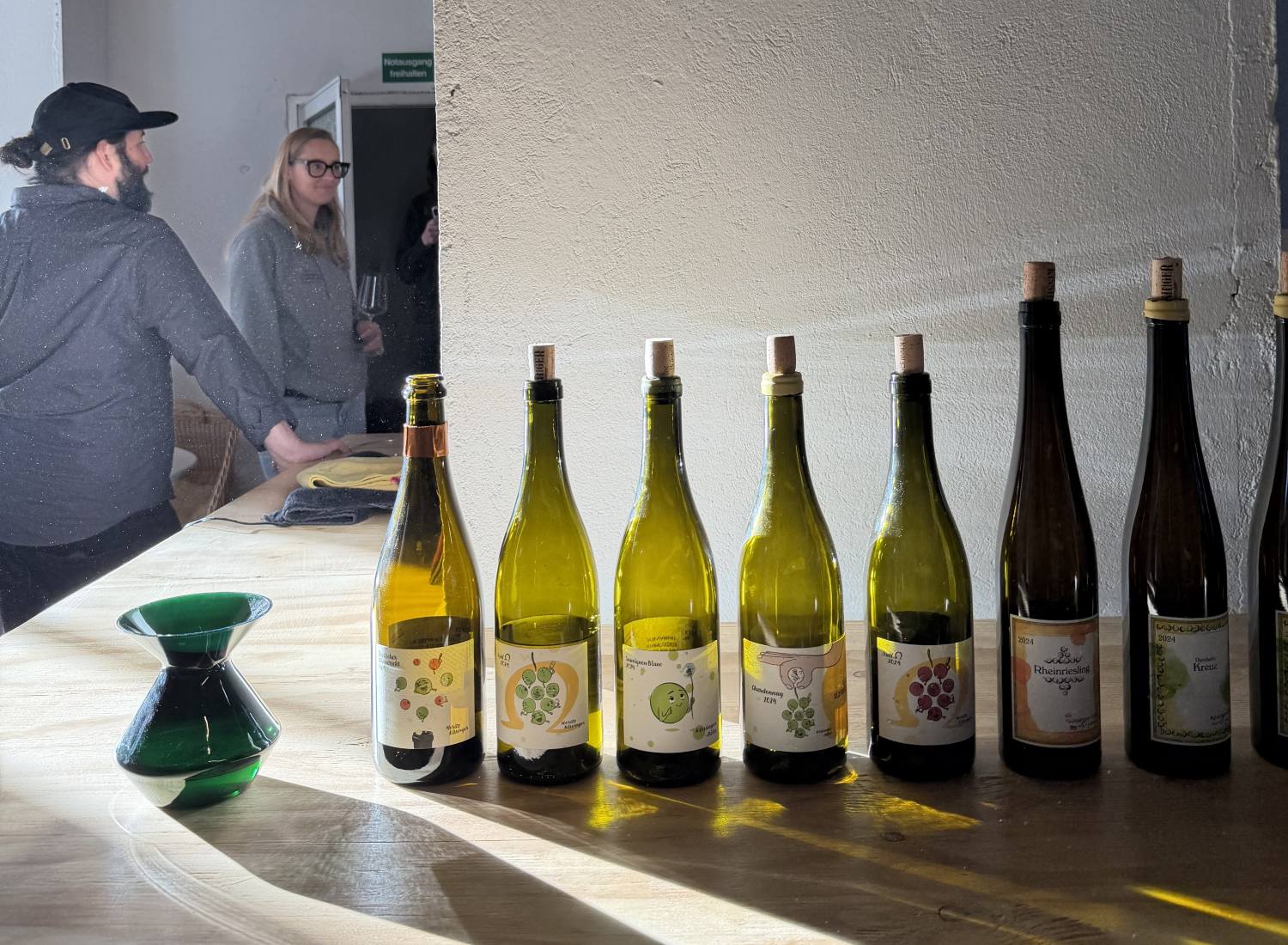
The spring sunset pours in at dramatic angles in the Rheinhessen, illuminating everything, including Dan W. and Jasmin Kissinger-Bähr, April 2026
die Weine | the wines – 2024 White and Red Wine Releases
For me, 2024 is a strong, to very strong, to great vintage for the general whites and reds of Germany, with a nod to the whites.
Why the whites? Well, I just mentioned that 2024 is a more classic vintage. For the whites, this means (most often, when handled well) clear flavors tautly held by a crystalline acidity. The fact that the Grand Cru dry Rieslings of 2024 can be so great must inform the general narrative that also lends itself to the dry Rieslings from the growers I’ll bunch under my own category called the “Neue Moselle.” This group of growers might be called “natural winemakers,” but they are, in fact, simply letting the wines age longer in barrel and are bottling, nearly always unfiltered, after the wines have gone through malolactic conversions.
What we have, to my sensibility, is a Mosel wine that speaks a bit to what we might think of as “Jura-esqe,” meaning wines with higher acidities, in certain cases a slight oxidation, or a reduction. Yet these wines of the “Neue Moselle” are nearly always much more linear, more delicate and porcelain – they rarely get much above 12% in alcohol and can clock in well below this.
The grower Julien Renard would be a case in point. Though in 2024 he would also be a horrible point, I guess(?), as his crop was nearly all destroyed by frosts and he survived the vintage by finding grapes at other growers and buying them. The wines are very good, but it is a curious vintage of adventures that, hopefully, will not be repeated anytime soon.
Similarly Philip and Rosa Lardot offer a spectrum of wines coming in, from the generous yet fresh 2025ers (a *great* Kontakt Pinot Noir and a delicately macerated Pinot Gris). Two 2024 red wines will come, and we’ll talk about those more somewhere else as they are absolutely stunning and very rare. Finally, their 2023 Grand Cru single-vineyard Rieslings come to us. So much is changed here that they also deserve some greater context. Check out our grower page for more.
In the limestone-riddled upper Mosel, or Obermosel, Jonas Dostert also crafted a great collection of 2024ers, though again, frost limited quantities.
Leaving the Mosel, 2024 is a lovely vintage for Burgundian grapes from many of the growing regions. The Chardonnays and Weissburgunders (Pinot Blancs) are blue-toned and precise, lively, firm, clear and long. I suspect they won’t be for everyone, though again, this is a classical vintage and it’ll speak to those with more classical tastes. Germany’s upward progress with Chardonnay is, honestly, shocking. Part of me feels like, “do we really need more Chardonnay?” And then the other part of me that drinks these wines next to white Burgundies ten to many more multiples the price can’t help but scratch my head.
At the top-top-top level, I haven’t quite had a German Chardonnay that can really go toe-to-toe with the most serious elites of white Burgundy (OK, the truth is I’ve had only one, but I’m not saying the bottle, though I will say it’s from Keller of course), but at the 1er Cru and mid-range level, game on. Any day, any time.
The Pinots of 2024 are perhaps more of a mixed bag. The most serious are firm, with a fruit quality that spans the gamut from red to dark-berry yet the heart of the wines are more herbal, stony, soil-toned.
If this is the general narrative, every producer obviously has their own say with the grape, the end results of course being wildly different from the Moselle down to Baden. I love Stein’s 2024 “Red Light,” for me it is the best since the 2019. But I think many people find it perhaps too light, too linear. Rosa and Philip Lardot have threaded the needle with a very singular style, retaining the freshness and cut of Stein’s “Kabinett Trocken” Pinot while offering more perfume, a bit more texture and structure.
Keller is of course killer. Maybe a special shout-out should go to Jasmin and Moritz Kissinger-Bähr: Their basic “0 Ohm” red (100% Pinot Noir) is absolutely fabulous.
Wasenhaus present one of their most linear collections, with beautiful detail and soil-tones, in both whites and reds. I tasted them rather quickly at the 10th anniversary party in April; I’m excited to revisit and go deeper when they arrive in July.
So here we are. A solid overview, with, by my standards at least, a pretty brisk word-count.
Let’s see what you think as the wines arrive. Let me know: orders@vomboden.com

The author and Hans Josef Becker in the Rheingau, April 2026