
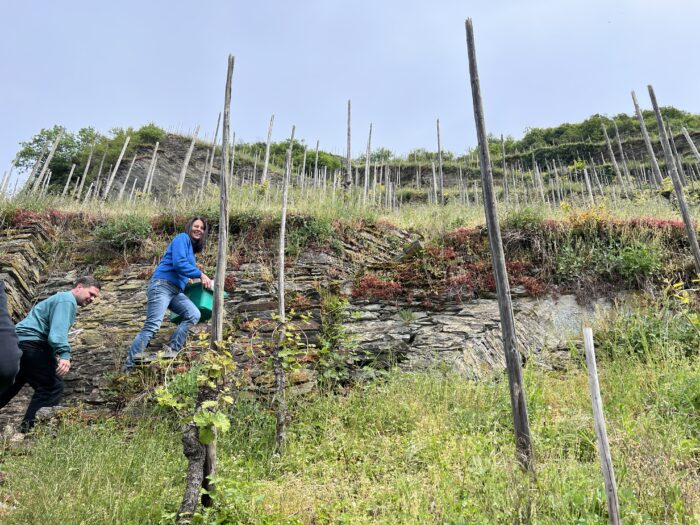
In 2005 Konstantin Weiser and Alexandra Künstler agreed to begin working a parcel of the Ellergrub vineyard, located on the Starkenburg Hang, just downstream from the village of Traben-Trarbach – the photograph above shows just one of the terraces of this amazing site. You can also take a very cool Google Earth vineyard tour of all of their vineyards by clicking here.
This is one of the steepest, most formidable vineyards I’ve ever experienced. In the nearly 20 years of taking customers to visit, we’ve had at least two occasions where people have had (albeit minor, thankfully) panic attacks due to the intense verticality of the site. This is winemaking at its most extreme, and because absolutely everything must be done by hand, it is winemaking at its most expensive.
Add to this the fact that the vines are very old – most are ungrafted and at this point are around (or over) 100 years of age – and therefore the yields are minuscule.
To say one does not do this for money is an understatement; to work a place like this, to dedicate your life to a site like this, is as great a spiritual calling as our rather secular world knows. Perhaps this is a bit nuts to mention – especially as I’m really just trying to sell you wine – but they both feel to me like deeply spiritual people, deeply sensitive. They have a way of holding themselves that is so quiet and peaceful. Even when they are 100% engaged with you, one has the sense they are, at least in a way, somewhere else as well. It’s a welcoming energy; you want to be around them, but it is not a world of back-slaps and loud laughs. It is a calm. A calm you want to be a part of.
This is the context to consider when approaching, thinking about, or tasting the wines of this amazing husband-and-wife team.
They are also, at least in the Mosel, perhaps the ultimate winemaker’s winemakers. I have never come across any estate, famous or not, that has expressed anything but awe for what these two do. In a world of compromises, compromises that are easy and lazy and speak to our weakest selves, but also those that are necessary and painful and speak to the awkwardness of the human condition, Alexandra and Konstantin seem to make no compromises.
They do, in a way, what I suspect most wineries would want to do, in some crazy, distant, ideal world that does not exist. But Weiser-Künstler does it regardless. It’s worth noting something curious: I have seen few people smile more than these two.
The 2025ers are arriving soon, marking an important anniversary for them: 20 years. I’m in awe.
The clichéd transition would be something like: “These wines will make you smile too.”
But maybe they won’t, if I’m being honest. Like I said, these are spiritual wines, not beverages for parties.
One of the most compelling arguments, for me personally, that the universe might not have any meaning is the simple fact that these wines are not worshiped.
The fact that I have to, year after year, explain why these are beautiful and magical – why they are poetry – baffles and saddens me. There are countless examples of the greatest among us – no matter the medium – being ignored in favor of things that are louder, easier, often more vulgar and simple. But I find little solace in this fact.
Purer, more humble and fairly priced expressions of one of the world’s oldest wine cultures simply do not exist. It’s true, a small minority fanatically collects these wines (I am one of these people), yet the larger audience seems to have no context or experience with them.
These are not easy wines; they are, I guess, not for everyone. But for those open to quiet beauty, to thoughts and whispers and long silences brought into clarity, please try and find these wines. And then treasure them.
Some notes on their 2025ers.
First, they are exceptional.
I think in general they are easier, perhaps, than they normally are. Which is to say they have a touch more fruit, a touch more perfume and friendly exuberance, than they normally do. Yet they are not too gregarious, don’t worry – they retain their distillate-like purity, their general aesthetic of tea-like aromatics, mineral-water gone kaleidoscopic.
There are really only two dry wines to speak of (the Grand Cru single-vineyards will be released in 2027): the village-level Trarbacher, which is I think this year the best it’s ever been. It is normally quite severe. This year a green apple skin, a lime zest freshness lifts it and dances with the salt and mineral. The Gaispfad Kabinett Trocken is also broader, even rounder than normal, though I write all this in the context of Weiser-Künstler’s normally very extreme style. This wine has the chance, perhaps, to speak to a broader audience, though the devout, like myself, will still be happy.
Even if there are not great quantities of the Prädikat wines, these are the push of the vintage – they are as beautiful as you’d imagine, from Kabinett to Spätlesen and above. It’s probably worth mentioning that in 2025, they made no fewer than four separate Auslesen – which is such a beautiful gesture, especially in this era of vilifying anything with sugar. They are so varied, so unique, so expressive of site – and honestly, so paltry in quantity – that they aren’t really worth talking about too much. Though if you can find them, please indulge.
Please visit our grower page and spread the good word of Weiser-Künstler.