
Stein’s 2025 single-vineyard collection has arrived and there is so much to say I almost don’t know where to start.
Maybe let’s begin with the personal? Then we’ll move to the pragmatic. And we’ll finish with the extraordinary – the story of Stein’s 2025ers.
In 2025, our vom Boden colleague and friend Collin Wagner and his wife Peggy had their first child, a daughter they named Charlotte. They call her “Lottie.” As it happened, in this vintage Stein had a section of his beloved Palmberg-Terrassen vineyard that showed a persistent and vigorous acidity. So much so that he decided to do something with these grapes he rarely ever does, and that is to make an off-dry, traditionally “fruity” as the Germans would say, Kabinett.
Stein, of course, has made a career crafting brutally dry Kabinetts, citric, salty and mineral. Yes, the Kabinett he makes from the Himmelreich vineyard most often has some residual sugar, but even this is normally just a touch. He labels the wine as a “Kabinett Feinherb” and it clocks in with around 20 grams of residual sugar per liter.
This rare Palmberg bottling is a fully off-dry Kabinett; the wine’s statistics are shocking. It comes to the table with 52 grams of residual sugar, which is right in the sweet spot for a “fruity” Kabinett – neither lean nor generous. Yet the dramatic backdrop here is an acidity of 9.5 grams, a formidable whiplash of treble that will leave the ears of the palate ringing for some time. “Zug!” as the Germans might say. Stein had not made such a Kabinett from the Palmberg like this since vintage 2017.
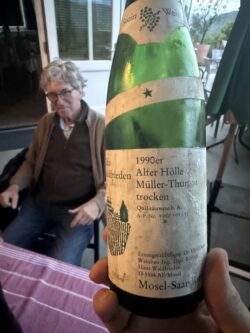
I don’t totally remember how the idea came to me. Maybe it was the damn acidity ringing in my soul. I know I was at Haus Waldfrieden. I know it was February, 2026. I suspect it was sometime early in the morning after another “strong” tasting. I remember looking at one of the back-vintage wines we had drank, a bottle with the older Stein-Haus Waldfrieden label. I had the vision: We could do a special redesign of the label, using this old label as inspiration, removing the Haus Waldfrieden logo and putting instead a drawing of baby Lottie – a special commemoration of her birth year, of Collin’s history at Weingut Stein (Collin worked harvests at Stein in 2017 and 2018, before he worked at vom Boden), of his love for Ulli’s rare Kabinetts. See the example below – this wasn’t the exact wine (says Ulli: “Müller-Thurgau could only ever get one star!”) or the night, but you get a sense of the old label design.
It just seemed to make sense. Ulli had only made 800 liters, planned on drinking most of it himself, and so it wasn’t hard to talk him into this idea. And that was that. So, if you see a Stein label from 2025 with the drawing of a beautiful baby girl, this is the wine, and this is why. (And then buy it, drink it, and count your lucky stars.)
Now to the pragmatic. Much of the following was taken from the Stein and Singley & Lyslo grower profiles already on our site, so if you’re a voracious reader of our content, the following news might not be surprising.
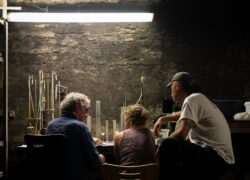
It’s also not exactly new news: Chad has been working with Stein for over a year; Megan for the past few months. Regardless, it is news: Chad Singley and Megan Lyslo, two American transplants to the Mosel, will take over Weingut Stein at some point in the near-ish future. For the moment, Stein, at 75 years of age, still has more energy than most people in their 50s – so for the foreseeable future, they will work together, as they have been for the past year or so.
The first year has been wonderful. When I talk to Ulli he’s in awe of their work ethic, their toughness. Chad and Megan feel like they’ve won the lottery, to be working next to this man. They all seem to be joyful together, to really enjoy each other’s company in a way that feels easy, natural. What can I say: It’s nice to be around this energy and optimism.
In a way, Chad and Megan could be viewed as Ulli Stein spiritually-intellectually replicated by the universe into two thirty-something Americans from Utah and Colorado, respectively. Stranger things have happened?
Let me briefly explain.
Chad has a bohemian streak, a certain wanderlust, an obvious inner strength and fearlessness which is, or likely could be, intimidating, though he is more prone to hugs and tears than fisticuffs. He has something that I know the young Dr. Stein had: the sensitivity of a poet, or an artist, which nonetheless does not preclude him from breaking a bottle over someone’s head were it justified. Before finding the Mosel, Chad spent years fishing in the rough north Atlantic seas and he has, let us acknowledge, some stories.
And Megan, Megan is something of Stein’s intellectual curiosity, made manifest. Megan got an undergraduate degree in biochemistry before studying winemaking at U.C. Davis. In a truly bizarre twist of fate, Megan had tasted some of Stein’s wines in 2020 and when she found out that he was a biologist, she emailed him asking if he might have offer any sort of apprenticeship. Stein, though brilliant, is not overly concerned with what we might traditionally call “organization” – the email was lost in the interweb.
Regardless, the universe takes little notice of human foibles and made the connection happen. And now we have Stein as the rebel in Chad; Stein as the scientist and intellectual in Megan. The future, for the first time in a bit, feels secure at Weingut Stein.
Which brings us to the extraordinary.
And the general plotline of this particular “extraordinary” is so confusing and counter-intuitive that I don’t exactly know how to approach it all, though I’ve decided to begin with a mini-diatribe on our culture’s obsession with youth which is, in my view, fucking stupid.
In our crea(pro)tein-botoxed-plastic-surgeried-looks-maxxing quest for never-ending youth and vitality, we have largely abandoned an idea that was central to many of our social structures, from the family to the tribe to the village and city. And that idea was that age had a relationship to wisdom, to a perspective removed from, and elevated above, the more trivial and reactionary tendencies of the younger set.
The sage, the wizard, the oracle, shaman, guru, prophet, scholar, philosopher, alchemist, mentor, counselor: Rarely did they speak of adipose tissue distribution, metabolic thresholds, or the perfectly defined jawline.
Where have the shamans gone? Where has the reverence for wisdom gone? Where is the awe for a logic that runs, not counter to expectations, but above these expectations?
Stein, at age 75, rarely speaks in the metaphysical vagaries of the shaman, but there is something about his intuition in the vintage 2025 that speaks to me of a deeper sensibility, of a non-verbal understanding of the world that eludes most of us.
Stein has forged a career making Rieslings of uncommon tension and acidity. If there was, historically, an unspoken idea that the later you waited to harvest, the greater the wine, Stein rarely followed this siren song. Even in his village of St. Aldegund, in a decidedly colder part of the Mosel, Stein was seldom the one waiting for the last moment to harvest. After all, acidity was something he cherished and, uniquely, the Kabinett, not the Auslese or rarified dessert wines, was his totem.
Yet in 2025, a vintage defined by vigorous rains in the middle and end of September, a vintage where nearly all the growers told me the most important thing was to harvest before the rains… Ulli Stein, inexplicably, waited.
Even during the harvest, when I pressed him, he really couldn’t explain why he was waiting. The best he could muster was a vague, “I just have a feeling.”
Here was a man who had defined himself for nearly half a century as someone who harvested toward the forefront of the crowd. Yet now, in a decidedly tricky harvest, while everyone rushed to get their fruit in before the rains, he waited.
Stein finished up his 2025 harvest on October 17th. I know this because he called me the next day, the 18th, absolutely spent, yet triumphant. He spoke of the beautiful, perfect, sunny yet crisp fall days that followed the September rains. He said they could harvest as they wanted, without pressure. It was perfect.
It could very well be that Stein was the absolute last person harvesting in the Mosel in 2025. Most of the growers I work with and had spoken to had finished weeks ago.
I’m not sure I believed him, but he insisted the fruit was glorious: ripeness was good, but not extreme, acids still rigorous. How exactly Stein’s sites could withstand the heat and dryness of 2025, the rains of September, and come out on the other side fresh, I didn’t… I still don’t, understand.
But they did.
Even Stein didn’t exactly understand it. It is curious to me that while he felt confident enough to wait, he couldn’t articulate to me either why he did this, or how the parcels had survived.
He had guesses. They had done exhaustive pre-harvests, removing every grape that looked like it might become problematic, before the rains. In other words, they had done very rigorous vineyard work and perhaps this had helped the parcels endure the rain. Perhaps they did not get quite as much rain in his village of St. Aldegund as some other villages had? The coolness of the September nights had kept things fresh. Maybe the preponderance of old vines, these ancient genetics with their small berries and deep roots, made all the difference?
Most likely it is some mix of all of this.
Yet for certain it the result of, a culmination of, a life lived among the vines for more decades than many of us have been alive.
It speaks to me of a wisdom that only comes with age. I don’t know how else to talk about this, to explain it – and by “it” I mean both Stein’s counter-intuitive harvest, as well as the brilliantly fresh and vigorous 2025ers.
The collection feels deeper, not rounder but more polished, yet still very linear and direct. These are Stein weins, in every way that ruthlessly entails.
For the first time since 2022, Stein has made a Spätlese from the “1900” vineyard – he was very proud of this. It is a Spätlese Trocken, and it weighs in as a featherweight at only 11.5%.
The singular Palmberg-Terrassen Kabinett, für Lottie, we have already spoken about. This is a serious rarity, the likes of which who knows when we’ll see again.
From the Palmberg, Stein has also made both a Kabinett and a Spätlese Trocken – the “white label” Kabinett and “blue label” Spätlese. Both have the Palmberg’s indelible minerality and herbal detail. This is what makes Palmberg, Palmberg. Stein thinks of his 2025ers in the same vein as the 2019ers. Interestingly, the only other grower that has strongly voiced this opinion, is Keller – to my mind one of the other great shamans of German wine. And it’s true that Stein’s 2025ers have more structure, an herbal glaze, a botanical edge, that speaks to me in some way of 2019. It is an extraordinary lineup of Palmbergs.
And finally, the Himmelreich Kabinett Feinherb: This is as zesty a Himmelreich as I can remember, unctuous yet with a forceful acid that makes the wine feel nearly dry. Honestly, it’s an amazing wine and though I called three bottles in from the warehouse to photograph for this post, I ended up drinking them before I photographed them. I’ve had this thought more than once: If it wasn’t for the mineral depth, the profound austerity and lift of the Palmberg, the Himmelreich would be a star in its own right.
Luckily, I suppose, you don’t have to choose. These are all testaments to, and from, the Mosel.