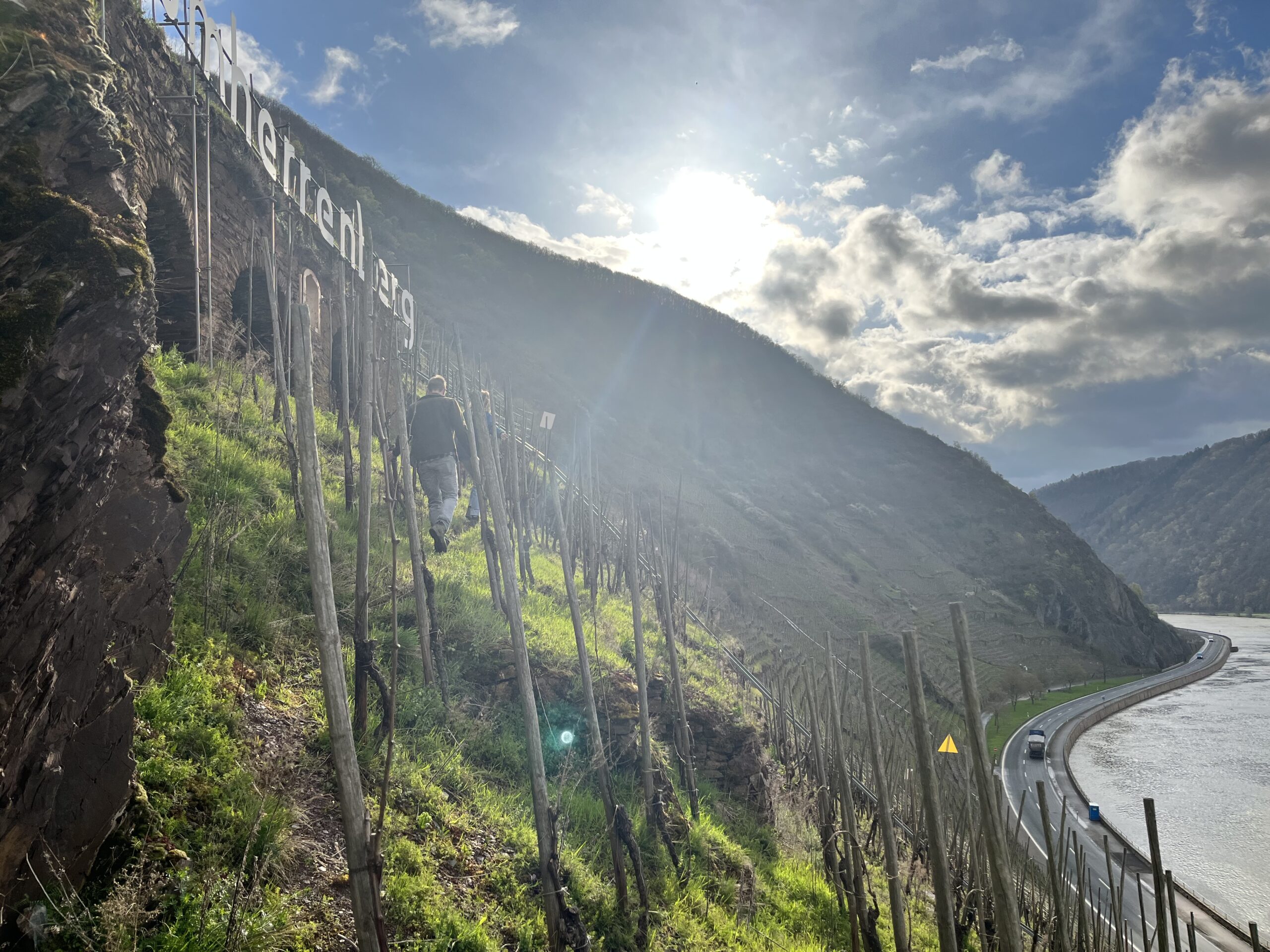
“The question is what do you call classic?”
“Is it how the wines were made 200 years ago? Or 100 years ago? Or do we look at the last two decades only and say, ‘This is what the Mosel is,’ because 95% of the wines are made this way? Maybe in some ways we’re more classic than what is seen as classic Mosel today.” Philip Lardot
What is a Moselle?
To some extent, this entire essay is based on the unquestionable fact that a dry Moselle is the greatest-ever oyster wine. “Why not drink a dry Mosel Riesling, rather than Muscadet, Sancerre, or Chablis with seafood?” writes the author Joachim Krieger in a great 2009 essay you can read here.
I myself have written extensively about the Mosel. I’ve written about the heroic small growers we represent there. I’ve written about the history of the Mosel, about what the valley is like today. I’ve written about the beauty and the challenges, the suffering, the sausages and water skiing.
What I want to talk about today is not the Mosel as a place, but the Mosel as a wine. I will refer to these wines as “Moselles,” honoring the British and American scholars of German wine from the late 19th and early 20th century. Why they used the French word to refer to a German place when writing in the English language eludes all logic and common sense, which is exactly what I like about it.
So note: When I write “Mosel” I mean the physical valley. When I write “Moselle” I mean a bottle of wine, nearly always a dry or dry-ish Riesling, from the valley of the Mosel.
I think it’s worth thinking about this subject for a moment because the category has been so defined, at least since the second world war, by both the most exceptional of the wines (TBAs and other desert wines) and the least exceptional of the wines (the lackluster and rather mass-produced sweet wines). Both of these genres most often involve a healthy dose of residual sugar and reference a dazzling range of smells and flavors that speak of opulently ripe fruit and heady perfume.
This is a Moselle as a caricature of itself: bloated, soft, oozing.
This is not the essence of the Mosel, this is not a Moselle, not for me.
For me, a Moselle is always severe, even when it has some residual sugar, as in its Kabinett form. (To me, the Kabinett represents the outer edge of what a Moselle can be. The Mosel can and does make superb Spätlesen, Auslesen, and above, and I love them. But these are simply superb Spätlese, or Auslese, etc. from the Mosel. They are not “a Moselle” in the classic sense.)
A Moselle can be elegant, of course it can, but a great Moselle is nearly always stern as well, brilliantly incisive, almost angular, cutting, sharp. In the world of wine, a Moselle is a razor blade made of sea mist and polished slate.
A Moselle is saline primarily – it is salty – mineral only second, herbal to complete the trilogy. Its main feature is acidity, the structure and energy and life-force.
A true Moselle makes a Muscadet feel common, it makes a Chablis feel like a warm, soft beanbag next to a roaring fire.
To me the gushing, rawness of a Moselle has a sibling in the wines of the Jura with their formidable toughness and saline composition. Yet the Moselle’s only equal in terms of weightlessness is Champagne, though Champagne needs the bubbles to mimic the lift of a great Moselle. (The delicate “prickelnd” of much Moselle perhaps speaks to the common genetic heritage of the two regions?)
But maybe this is the point to come back to the valley itself, because the rawness of the valley, even its poverty and crudeness, has hurt it as a destination. And this, in turn, has hindered both the reputation and the understanding of its wines. Those suburban neighbors who “collect wine” and will tell you (over and over again) about their trip to Tuscany have never been to the Mosel. Perhaps all they know of it are the most expensive sweet wines they cannot find nor afford, or the most common sweet wines which they cannot avoid nor stomach.
But its not only the lack of a serious, curated tourism that has hurt the Mosel. The complications are structural as well. Like Burgundy, the small-grower reality of the best wines of the Mosel means that visits are not simple or easy. Unlike Burgundy, the problem is not the demand nor the resulting exclusivity or expense.
The problem is time. The problem is that the growers don’t have the time for visitors.
The incredible amount of physical labor necessary to farm in this extreme landscape, with its steep, terraced vineyards, means that the growers whose names are on their labels are also, most days, in their vineyards. They don’t have the time to be at the estate enough to welcome thralls of visitors, though the fact that there are no thralls of visitors coming is the problem’s vicious circle.
Yet the problem is also the money. The economics here are much too severe to provide for margins that could be used to pay for fancy tasting rooms, sales managers, or even tasting-room brats – to provide, in other words, for marketing, for education, for articulation.
And so we are left with a void, of sorts – a void filled by stories woven in a post-war era of miraculous, and disastrous, growth for the Mosel, and for Germany. A void filled by the awful truth that the best way to forget the past was to never look back, to turn ones back against the old terraces, the old traditions, even the old vines.
Today, the great irony is the only way to save the Mosel will be to look back.
And so, we humbly present two growers who are looking back as a way of going forward. Rosa and Philip Lardot have slowly been growing and refining their focuses, their parcels, their bottlings. We are thrilled to release our newest film about the estate, about the realities of working in the Mosel today.
And we are thrilled to introduce Chad Singley and Megan Lyslo of Singley & Lyslo, another pair of young immigrants to the Mosel, binding their future to the future of this magical valley. Click the image below to learn more about their project.
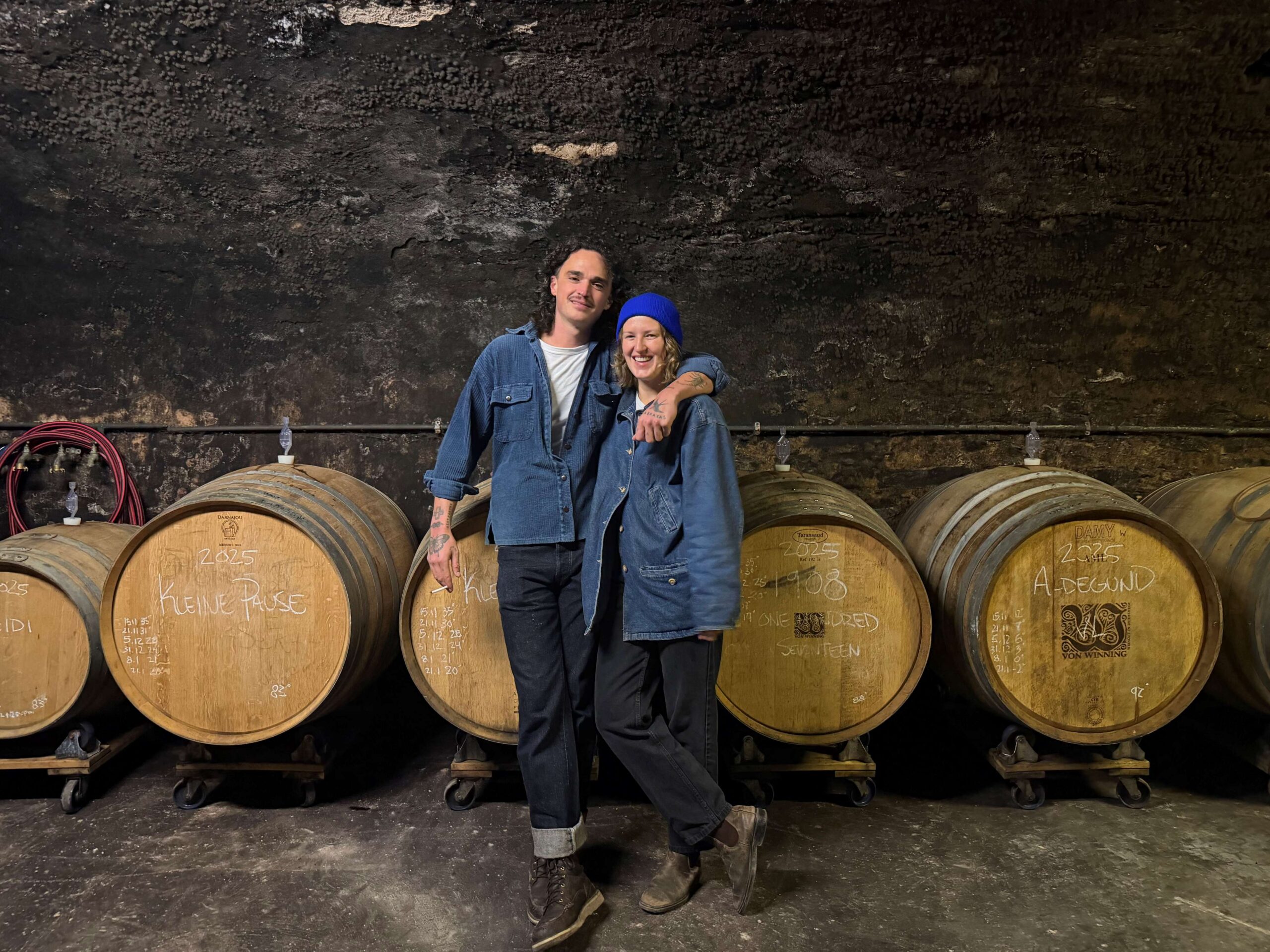
Chad Singley and Megan Lyslo are American immigrants in the Mosel. They are working full-time with Ulli Stein and making their own wines on the side. Click the photo above to learn more.
It is here, in the forgotten Mosel, where we arrive at the work of the Lardots and Singley & Lyslo. These four young growers are farming a landscape of sacred, yet-abandoned, sites.
It is more than simply a story of saving parts of the Mosel. It is also a story of asking what is the tradition, the style, the taste, of a Moselle.
To pigeonhole their work as a “natural wine” movement would be selling it short, if not blatantly misrepresenting it. The inspirations are less a rebellion against what came before and more a thoughtful approach to a region that actually recalls parts of the pre-war heritage of the Mosel.
In a certain way, the estates could not be more traditional. In some ways what we perceive as a “new style of Mosel winemaking” has very clear echoes from the famously dry Moselles of the late 19th century. This was, after all, a period long before filters and the ability to block malolactic conversions.
I had a conversation with David Schildknecht, one of the great scholars of German wine, about this idea and he pointed out the following. In so far as growers like the Lardots and Singley & Lyslo recognize and value selection massale (which most certainly they do in this old-vine part of the Mosel), in so far as they follow viticultural regimens less influenced by the technologies of the 20th century, in so far as they have a rather relaxed attitude toward malolactic conversions and value the delicacy and lightness of a Moselle, all of these characteristics would be applicable to the fin-de-siecle Mosel.
Yet, while a longer élevage could be seen as a throwback to a more “traditional” winemaking, in the late 19th century of Mosel wines, most of these wines were actually bottled quite early. Relying on spontaneous fermentation could also be seen as a “traditional” way of winemaking, yet Schildknecht pointed out to me that cultured yeasts were already in widespread use by the late 19th century in certain parts of the Mosel.
In the end, my point is less that this “new” style of Mosel winemaking is exactly like it was 100+ years ago. While I don’t think it’s unreasonable to speculate that some of these wines may taste more like the wines made in the Mosel 150 years ago than do the contemporary Prädikat (off-dry) wines of many famous estates, this isn’t really my point either.
My point is more that culture is alive, that tradition is not static and is always evolving, changing, right under our noses. I strongly believe this style of winemaking in the Mosel has a powerful precedent and an influential future ahead of it. This is an authentic avant-garde.
There is no question to me that these outsiders, farming these forgotten, old vines in the poorest and least-known villages of the Mosel, working the terraces, and dedicating themselves to this beautiful yet financially difficult existence, they are the cavalry the Mosel needs so desperately right now.
But they also need help, desperately. Even in good times the labor of the Mosel is extreme; the inexpensive prices demanded by the market, simply unreasonable. We are at a crossroads, with two futures in view. In the dystopian future, we ask the growers to subsidize this culture, these wines, through their own poverty, selling wines for ten dollars that cost them twelve to produce. This is unsustainable; eventually, they will stop.
The other possibility is that we support them by buying and sharing their wines, that we shout from the rooftops about this sacred place, our common collective history, and the duty to preserve it.
Our role, in short, is to SAVE THE MOSEL, to support the growers working the steep slopes of the Mosel.
If not, as the infamous Dr. Ulli Stein once said in a The Art of Eating article many years ago, for the lovers of the Mosel, “then at least to honor the old Rieslings vines themselves, which have earned a chance to be protected from thorns.”